
Best Biometric Screening Options for Hybrid Workforces
A comparison of biometric screening for hybrid workforce models that cover in-office and remote staff equally, with participation, cost, and equity tradeoffs.
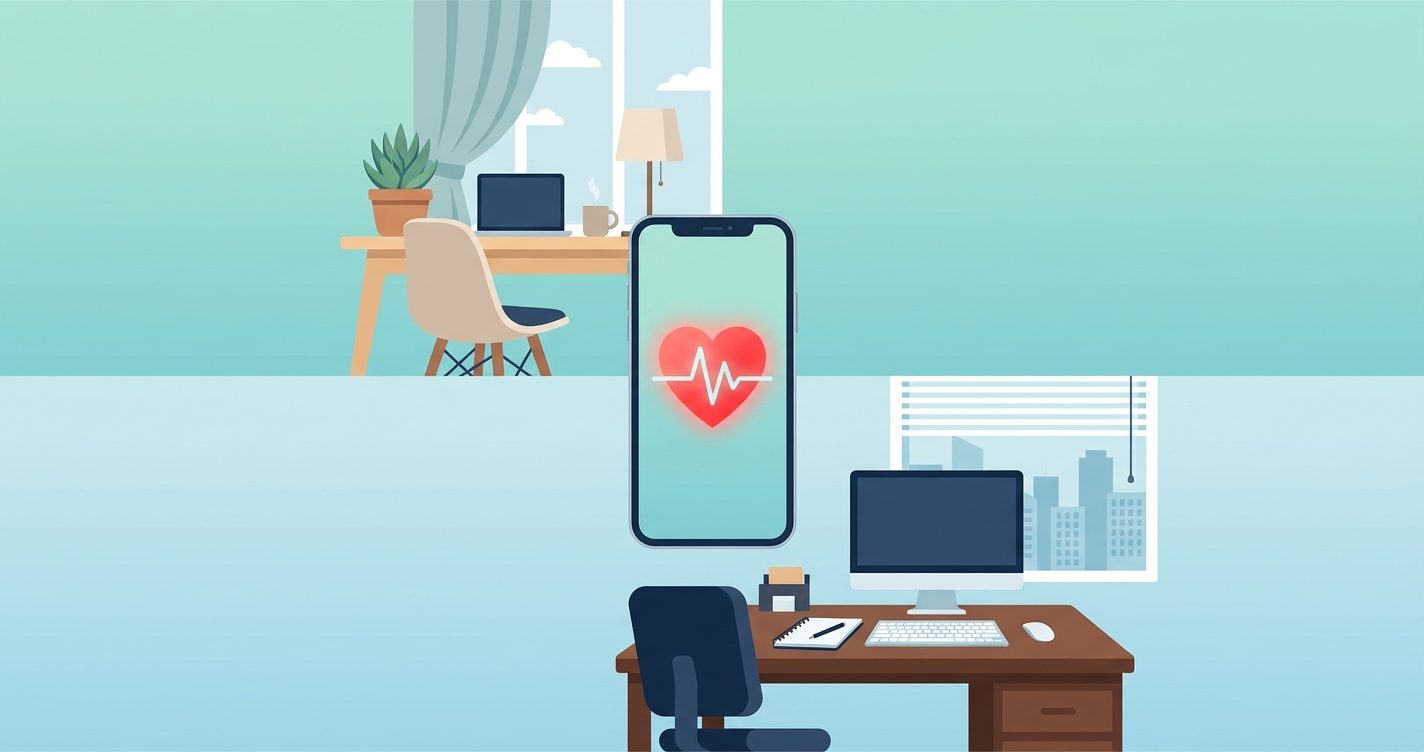
The biometric event that worked when everyone reported to one building no longer matches how people actually work. Most benefits teams built their screening calendar around a conference room, a row of folding tables, and a phlebotomy vendor booked months in advance. That design assumes a single location and a synchronized workforce, and neither assumption holds anymore. Building an effective biometric screening for hybrid workforce programs means treating the home-based employee and the in-office employee as equal participants rather than designing for one and improvising for the other.
roughly 52 percent of remote-capable U.S. employees worked in a hybrid model, and 88 percent of U.S. employers now offer at least some hybrid options, according to Gallup and Owl Labs survey data.
When more than half of an addressable population is splitting time between locations, a screening model anchored to one site structurally underserves them. The result is predictable: in-office staff get convenient access during an onsite event while remote and hybrid staff are told to find a participating clinic on their own time. Participation gaps follow the access gaps, and the data an employer collects ends up skewed toward whoever happened to be in the building that week.
Why biometric screening for hybrid workforce models breaks the old playbook
Traditional onsite screening was optimized for a specific set of conditions. Employees worked in one place, could fast the night before and step away from their desks for fifteen minutes, and the marginal cost of adding one more person to a booked event was low. Onsite screenings have long been recognized as more cost-effective per participant than provider-based screening, and well-incentivized onsite programs have reached participation rates as high as 99 percent in single-site settings.
The trouble is that those efficiencies collapse as the workforce distributes. A vendor who needs a minimum headcount to justify a visit cannot economically serve a satellite office with eleven people or a fully remote engineer in another state. Employers respond by offering a patchwork: an onsite event for headquarters, a physician form for everyone else, and a lab voucher network for the people in between. Each channel carries its own cost, its own data format, and its own completion rate. The 2024 KFF Employer Health Benefits Survey found that 44 percent of large firms still offered biometric screening, but the survey also noted growing demand for location-flexible delivery as fixed-site models lose reach.
For a hybrid wellness program to be defensible, it has to deliver the same experience and the same data fields regardless of where the employee opens the assessment. That is the core design problem this category is now trying to solve.
Comparing screening approaches for distributed teams
The practical question for an employer health consultant is not whether to screen, but which delivery model covers in-office and remote staff with comparable equity, cost, and data quality. The table below compares the four approaches most employers evaluate.
| Approach | In-office coverage | Remote employee screening | Cost structure | Typical participation | Data consistency |
|---|---|---|---|---|---|
| Onsite event (nurses/phlebotomy) | Strong | Weak to none | High fixed cost, headcount minimums | High at single sites, low for distributed staff | Uniform lab panel |
| Retail lab / clinic voucher network | Moderate | Moderate | Per-test fees plus admin overhead | Often 20 to 40 percent without strong incentives | Varies by lab and panel |
| At-home test kits (mail-in) | Moderate | Moderate to strong | Per-kit plus shipping and lab processing | Moderate, limited by kit return rates | Depends on sample handling |
| Smartphone-based digital screening | Strong | Strong | Per-employee software cost, no venue | Higher when access friction is removed | Uniform across all employees |
A few patterns stand out for distributed workforce health checks:
- No single legacy channel covers both populations well. Onsite events serve the office and miss remote staff; voucher networks reach remote staff but lose convenience and consistency.
- Cost scales differently. Fixed-site models get cheaper per head with density and more expensive as people spread out. Per-employee digital models stay roughly flat regardless of geography.
- Participation tracks access friction more than motivation. Unincentivized programs see median participation near 20 percent, while removing scheduling and travel barriers is one of the most reliable ways to lift completion.
- Data fragmentation is a hidden tax. Running three delivery channels means reconciling three data formats before anyone can act on aggregate risk.
Industry applications across hybrid models
Headquarters-plus-remote employers
The most common hybrid pattern is a central office with a meaningful share of remote and traveling staff. Here the failure mode is a two-tier program: a polished onsite day for headquarters and a neglected mail-in or clinic option for everyone else. A unified digital layer lets the in-office group screen at their desks alongside remote colleagues, which closes the equity gap that benefits committees increasingly get asked about.
Multi-site and franchise operations
Organizations with many small locations rarely hit the headcount minimums that onsite vendors require. Sending nurses to a site with fifteen employees is rarely economical, so those sites get skipped year after year. A per-employee screening model removes the headcount math entirely and gives every location identical access.
Fully distributed and deskless segments
Some employers have no central office at all, or have a large field and deskless population that never sits at a workstation. For these groups, smartphone-based screening is often the only channel that reaches everyone without forcing personal time off or out-of-pocket travel. This is where remote employee screening stops being a fallback and becomes the primary method.
Current research and evidence
The evidence base points in two directions at once. First, onsite screening remains genuinely cost-effective when density is high. A widely cited analysis covered by Employee Benefit News found onsite biometric screening more cost-effective than primary-care-based screening, and the 2024 KFF survey confirmed that 65 percent of large firms offering screening use incentives or penalties to drive completion. Incentive design clearly works: GiftCard Partners reported that well-structured incentive programs have pushed participation toward 99 percent.
Second, the workforce those models were built for has changed. Gallup's ongoing hybrid work tracking and the Owl Labs State of Hybrid Work 2025 report both place hybrid arrangements at roughly half of remote-capable employees, with U.S. office occupancy averaging only about 54 percent in early 2025. A screening model that performs at 99 percent in a full building performs very differently when only half the population is ever in that building on a given day.
The synthesis for hybrid wellness programs is straightforward. The mechanisms that drive participation, namely low access friction and clear incentives, are well documented. What has shifted is the delivery channel best positioned to deliver low friction to a population that is no longer concentrated in one place. Independent research has not yet produced large head-to-head trials of smartphone-based screening against onsite events for distributed workforces, which is a genuine gap consultants should name when advising clients rather than overclaim.
The future of biometric screening for hybrid workforces
Three developments are likely to shape the next few years of distributed workforce health checks.
- Convergence on per-employee economics. As workforces stay distributed, pricing that scales with headcount rather than venue will become the default, because it is the only structure that survives geographic spread without punishing small sites.
- A single data standard across channels. Employers will pressure vendors to deliver one consistent dataset whether an employee screens at a desk, at home, or at a clinic, so aggregate population health reporting stops being a reconciliation project.
- Equity as a procurement requirement. Benefits committees are beginning to ask explicitly whether remote staff receive the same screening access as in-office staff. Expect that question to move from nice-to-have into formal RFP criteria.
The employers who handle this well will stop thinking of remote screening as an exception bolted onto an onsite event and start designing a single program that happens to reach people wherever they are.
Frequently asked questions
What is the best biometric screening option for a hybrid workforce?
There is no single answer for every employer, but the strongest fit is usually a delivery model that gives in-office and remote staff identical access and produces consistent data. Smartphone-based and at-home options reach distributed staff that onsite events miss, while a unified platform avoids running three disconnected channels.
How do I screen remote employees who never come to the office?
Remote employee screening typically relies on mail-in test kits, retail lab voucher networks, or smartphone-based assessments. The deciding factors are completion rate, data consistency, and how much administrative overhead each channel adds for your benefits team.
Do hybrid wellness programs still need onsite events?
Onsite events still make sense for high-density locations where headcount easily justifies a vendor visit. The issue is coverage: if a meaningful share of staff is remote or spread across small sites, an onsite-only program will leave large gaps that hurt both participation and data quality.
How do hybrid screening models affect participation rates?
Participation tracks access friction closely. Unincentivized programs often sit near 20 percent participation, while removing scheduling and travel barriers, paired with clear incentives, is among the most reliable ways to raise completion across both office and remote populations.
Circadify is building toward exactly this problem, giving employers a way to screen in-office and remote staff through one consistent, phone-based experience rather than stitching together onsite events and clinic vouchers. To see how a scalable model handles a distributed workforce, request an enterprise wellness demo.