Best Biometric Screening Options for Hybrid Workforces
Compare biometric screening for hybrid workforce models that cover in-office and remote staff equally, with participation data and a buyer's framework for 2026.
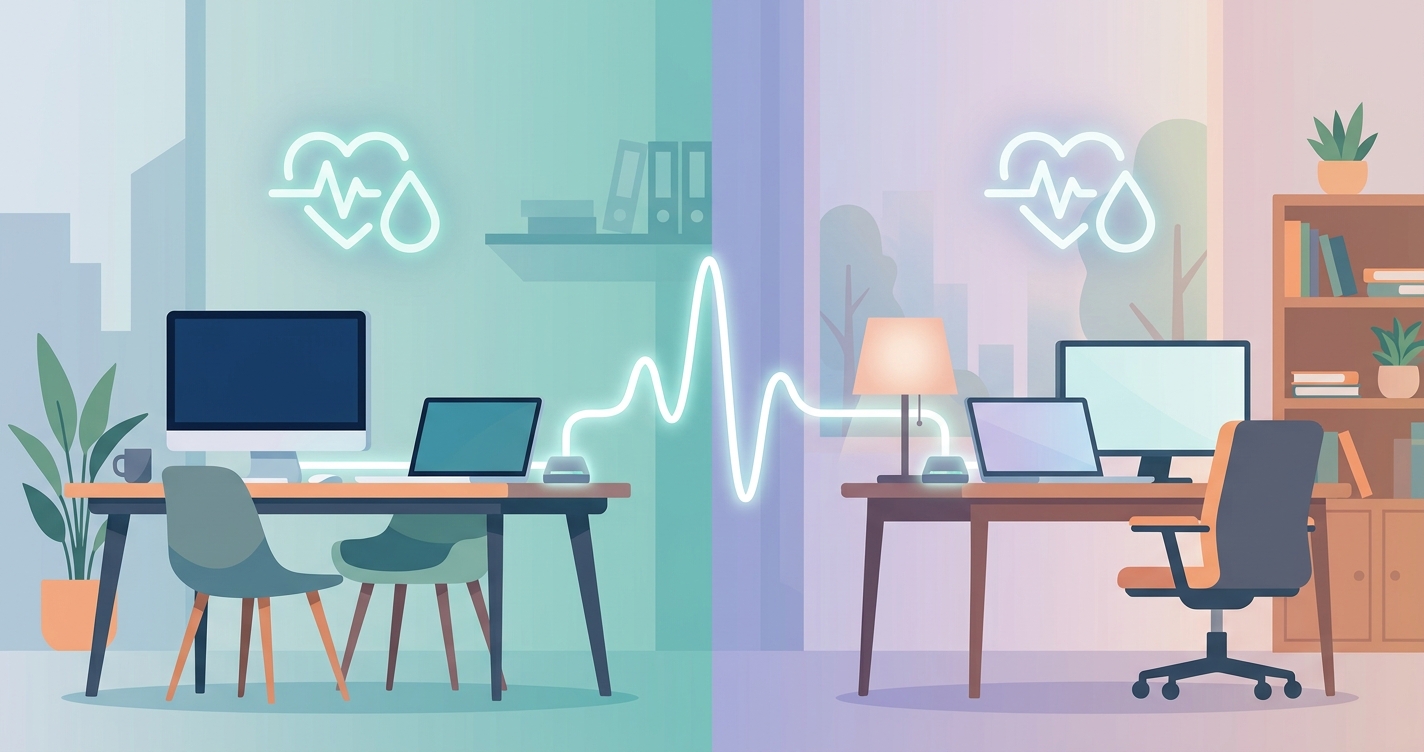
The biometric event that worked when everyone reported to one building no longer matches how people actually work. With roughly 53% of remote-capable U.S. employees in a hybrid setup and another 27% fully remote as of 2025, the typical employer is now trying to screen a population that is split across home offices, regional hubs, and the occasional in-person day. Choosing the right biometric screening for hybrid workforce coverage has become a procurement decision, not a logistics one, and the wrong model leaves a measurable slice of the workforce unscreened, underinsured against risk, and disengaged from the wellness incentives the employer is already paying for.
"Employee participation rates in wellness programs average 25 to 30% in mid-sized firms, and offering remote-accessible screening is one of the few levers that consistently moves that number for distributed teams.", Workplace wellness benchmarking, Recruiters LineUp, 2025
Why biometric screening for hybrid workforce coverage breaks the old model
The traditional onsite screening event was designed around a single assumption: employees share a physical location, can fast the night before, and can spare 20 minutes in a conference room on a scheduled day. That assumption collapses the moment a third of your headcount works from a different ZIP code. When a benefits team books nurses for a one-day event, the remote and hybrid segments either skip it entirely or get routed to a patchwork of lab vouchers and physician forms that arrive weeks late and rarely close the loop.
The result is a two-tier program. In-office staff get a convenient, well-attended event. Remote staff get friction, and friction is the enemy of participation. For employer health consultants advising on plan design, the practical question is no longer "which vendor runs the best event" but "which screening approach treats an in-office employee and a remote employee as equally reachable." That is the standard a credible biometric screening for hybrid workforce program has to meet.
There are four broad approaches in market today. Each covers part of the population well and part of it poorly.
| Screening Approach | In-Office Coverage | Remote Coverage | Admin Burden | Typical Turnaround | Best Fit |
|---|---|---|---|---|---|
| Onsite event (nurses) | Strong | Weak | High (scheduling, space, staffing) | 1 to 3 weeks | Single-site employers |
| At-home test kits | Moderate | Strong | Moderate (shipping, returns, error rates) | 2 to 4 weeks | Fully remote teams |
| Retail lab vouchers | Moderate | Moderate | Moderate (employee must travel) | 1 to 2 weeks | Geographically clustered staff |
| Phone-based digital scan | Strong | Strong | Low (no scheduling, self-serve) | Minutes to days | Hybrid and distributed teams |
- Onsite events deliver high data quality but exclude anyone who cannot attend in person on the assigned day.
- At-home kits reach remote staff but introduce sample-handling errors, shipping delays, and return-rate drop-off.
- Lab vouchers shift the burden to the employee, who has to find a participating location and book a slot.
- Phone-based digital screening removes scheduling and travel entirely, which is why it tends to score evenly across both segments.
Industry Applications for distributed workforce health checks
No single method wins for every employer. The right choice depends on workforce geography, plan incentives, and how the benefits team plans to use the data downstream. Below are the patterns that hold up across distributed workforce health checks.
Hybrid corporate teams
For an employer with a headquarters plus a large work-from-home contingent, a blended model usually performs best on paper but worst in practice, because running two parallel programs doubles the administrative load and creates the two-tier experience described above. A single self-serve method that works identically whether the employee is at a desk or at home is the cleaner solution. This is the core case for remote employee screening that does not depend on shipping or appointments.
Fully remote and multi-state employers
Distributed employers face an added complication: lab networks and licensing rules vary by state, and at-home kits face different return logistics depending on the carrier. A phone-based scan sidesteps state-by-state lab availability, which is why fully distributed teams gravitate toward it for baseline screening even when they keep lab confirmation as a second step for flagged results.
Deskless and frontline segments
Manufacturing, retail, and field staff rarely have a quiet 20 minutes or a private email inbox during a shift. Hybrid wellness programs that assume a laptop and a calendar invite miss these workers entirely. A method that runs on a personal phone in under a minute reaches the segment that onsite events and email-based kit programs leave behind.
Current research and evidence
The evidence base points in one direction: convenience drives participation, and participation is where wellness programs either earn their budget or quietly fail. Industry benchmarking from Recruiters LineUp (2025) places average wellness participation at 25 to 30% in mid-sized firms, and notes that flexibility and location-independence are among the strongest predictors of higher engagement. Broader workplace data reinforces the stakes: 89% of organizations now offer corporate wellness programs and 72% of employers rank well-being as a strategic priority for 2025, yet participation lags adoption by a wide margin.
The structural reason is well documented. Quest Diagnostics and other screening providers report that employers routinely struggle with low onsite participation because employees find it hard to attend in-person appointments, and that remote alternatives such as home kits, lab vouchers, and physician forms exist precisely to close that gap. The COVID-era shift to distributed work accelerated this, turning what was a convenience feature into a coverage requirement. Workplace wellness analysis from Shortlister and Wellable (2024) similarly frames flexibility and personalization as the defining trend, with screening modality cited as a primary friction point for remote staff.
What the research does not yet settle is comparative data quality across methods at scale. Onsite venipuncture remains a high-quality reference standard, while newer phone-based and at-home approaches trade some precision for reach. The practical reading for benefits teams is to match the method to the goal: a baseline risk-stratification and engagement program tolerates a screen-first, confirm-later design, whereas a clinical diagnostic workflow does not. No screening modality should be presented as a substitute for a physician's diagnosis.
The Future of biometric screening for hybrid workforce programs
Three shifts are likely to define the next few years. First, the default will invert. Where onsite events were the baseline and remote was the exception, distributed-first screening will become the standard and the in-person event will be the add-on for employers who want it. With hybrid and remote together accounting for roughly 80% of remote-capable workers, the math no longer favors a building-centric model.
Second, expect screening to fold into existing employee touchpoints rather than standing alone as a once-a-year event. Open enrollment, onboarding, and quarterly engagement campaigns are natural windows, and a phone-based method can attach to any of them without booking nurses or shipping kits.
Third, the value will move from the measurement to the follow-through. Collecting a number is easy; routing an employee with an elevated reading to the right next step, while keeping individual data private from managers, is the harder and more valuable problem. The screening platforms that win will be judged less on the scan itself and more on how reliably they close the loop across an entire distributed population.
Frequently asked questions
What is the best biometric screening option for a hybrid workforce?
There is no single answer, but the strongest fit for mixed in-office and remote teams is a method that works identically regardless of location. Onsite events favor in-person staff, and at-home kits favor remote staff. A self-serve, phone-based scan tends to score evenly across both segments because it removes scheduling, travel, and shipping. Many employers pair a screen-first digital method with optional lab confirmation for flagged results.
How do you screen remote employees who cannot attend an onsite event?
The common remote employee screening options are at-home test kits, retail lab vouchers, physician result forms, and phone-based digital scans. Kits and vouchers work but add shipping delays, sample errors, or travel friction. Phone-based scans avoid those by running on a personal device, which is why distributed and multi-state employers increasingly use them for baseline screening.
Do hybrid wellness programs need two separate screening methods?
They can run two methods, but it usually creates a two-tier experience and doubles administrative work. A single location-independent method that both in-office and remote staff use is simpler to run, easier to report on, and produces more comparable participation across the workforce.
How accurate are remote biometric screening methods compared with onsite blood draws?
Onsite venipuncture remains a high-quality reference standard. Remote methods trade some precision for reach, which is acceptable for baseline risk stratification and engagement but not a replacement for clinical diagnosis. The practical approach is to match the method to the goal and confirm flagged results through a lab or physician.
Circadify is building toward this distributed-first standard, with phone-based screening designed to reach in-office, hybrid, and fully remote staff through the same workflow. Employer health consultants evaluating scalable options for mixed teams can see how the approach handles a full distributed population in an enterprise wellness demo.