Corporate Health Screening and Workers Comp: How They Connect
Corporate health screening and workers comp are more connected than many employers realize, especially when screening data is used to spot risk patterns early.
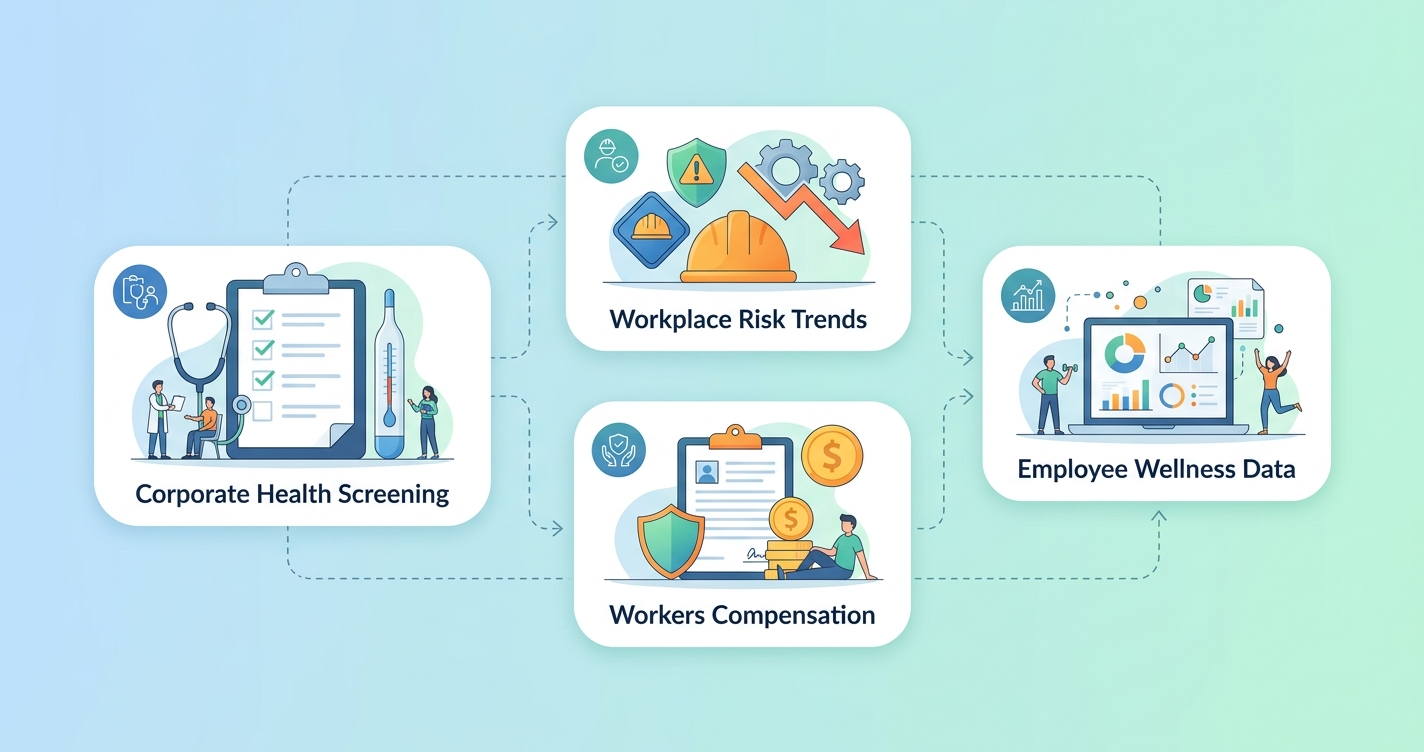
Corporate health screening and workers comp are usually managed in different meetings, by different teams, with different budgets. HR owns wellness. Risk or finance owns claims. Occupational health handles incidents after the fact. But the research keeps pointing in the same direction: the workforce factors that show up in health screening data often overlap with the factors that make workers' compensation claims more expensive, slower to resolve, and harder to predict.
"Claims with comorbidities had substantially higher costs and longer duration of temporary disability, much higher for claims with multiple comorbidities." — Dr. Vennela Thumula, Workers Compensation Research Institute presentation on 32-state claims data, 2025
Why corporate health screening workers comp discussions are converging
The old model treated workplace injury risk and employee health risk as separate problems. That division made some sense when screening was an annual event and workers' compensation was viewed mainly as an insurance function. It makes less sense now.
The U.S. Bureau of Labor Statistics reported 2.57 million nonfatal workplace injuries and illnesses in private industry in 2023, with an incidence rate of 2.4 cases per 100 full-time equivalent workers. That is still a huge volume of claims, paperwork, lost time, and downstream cost even after the post-pandemic decline. At the same time, employers are sitting on more screening data than they used to, whether it comes from HRAs, biometric events, primary care partnerships, or digital screening tools.
When employers look at those datasets together, a practical pattern shows up. Workers comp does not start and end with the injury itself. Severity, recovery time, return-to-work planning, and repeat risk are often shaped by stress, chronic conditions, and barriers to engagement that screenings can surface earlier.
| Lens | Traditional wellness view | Workers comp view | What connected programs see |
|---|---|---|---|
| Purpose | Improve employee health engagement | Pay and manage claims | Reduce avoidable risk and recovery friction |
| Timing | Usually annual or periodic | Triggered after injury | Continuous signal before and after incidents |
| Data owners | HR, benefits, wellness vendors | Risk, TPA, insurer, safety | Shared governance across HR, safety, and finance |
| Main metrics | Participation, risk scores, referrals | Claim cost, lost days, reserve development | Risk trend detection, recovery support, cost trend management |
| Employer question | Who may need support? | Why did this claim get expensive? | Which patterns should we act on earlier? |
That is why more corporate wellness leaders are getting pulled into workers comp strategy, and why benefits brokers increasingly frame screening as part of a broader employer risk architecture rather than a once-a-year perk.
What the evidence says about screening data and claim outcomes
One of the more useful studies here came from a multi-employer cohort published in Occupational and Environmental Medicine. Researchers including Dr. Jennifer R. Reme and colleagues examined 16,926 employees across 314 businesses and found that several health risk factors were associated with future workers' compensation claim occurrence and cost before work-organization factors were added to the model. After adjustment, stress still stood out, especially work-related stress, as a predictor of claim occurrence.
That detail matters. Employers often think of corporate screenings as a way to spot biometric issues alone. The literature suggests the more valuable signal may be broader: stress, sleep, obesity, blood pressure, glucose risk, and other factors can influence injury exposure, recovery, and work capacity in ways that show up downstream in claims.
The Workers Compensation Research Institute pushed that point further in its 2025 work on degenerative and comorbid conditions. Using more than 930,000 lost-time claims across 32 states, WCRI found that claims with comorbidities had materially higher medical payments, indemnity benefits, and temporary disability duration than claims without those conditions. In the presentation accompanying the research, nearly 39% of claims had one or more comorbidities, and almost half of those involved multiple comorbidities.
That does not mean a screening program should be sold as a magic workers comp prevention device. It does mean employers are making a mistake if they ignore the overlap.
A second strand of evidence comes from obesity and cost severity research. In a 2016 study indexed in PubMed, Dr. Seth A. Seabury and coauthors reviewed 2,301 lost-time workers' compensation claims and found that for severe injuries, overweight and obese claimants had more than double the odds of incurring claim expense of at least $100,000 compared with normal-weight claimants. The effect did not show up the same way for minor injuries, which is exactly the kind of nuance employers need. Health status may not change every claim, but it can change which claims become financially painful.
Where health screening fits in the workers comp workflow
The useful role of screening is not adjudication. It is earlier visibility.
Employers that connect screening data to workers comp planning usually use it in four ways:
- They identify workforce-level risk patterns by site, shift, job type, or population segment.
- They design prevention efforts around patterns that repeatedly show up in expensive claims, such as stress, hypertension, poor sleep, obesity, or unmanaged chronic conditions.
- They build post-incident support workflows that account for baseline health complexity instead of assuming every recovery path is similar.
- They give finance and HR a shared dataset for evaluating whether wellness spending is helping the employer absorb fewer high-cost surprises.
This is closer to the Total Worker Health framework promoted by NIOSH than to a standard wellness challenge. NIOSH's worker health research has argued for years that employers get better outcomes when they stop separating health protection from health promotion. In plain English: if the same employee population is generating both biometric risk signals and injury claims, those datasets should probably talk to each other.
Population risk stratification
A good screening program helps employers see risk concentration before a claim file is opened. Maybe one manufacturing location has much higher stress scores and poor sleep patterns. Maybe a warehouse population shows rising hypertension and obesity trends. Maybe a call center group reports high burnout that later shows up as musculoskeletal and mental-health-driven absence.
Workers comp leaders care about these patterns because claim severity rarely appears out of nowhere. It often builds inside a workforce that has been signaling strain for months.
Recovery planning after an incident
Claims do not get expensive only because of the original injury. They get expensive because recovery stalls, care becomes fragmented, and return-to-work plans fail. Screening cannot diagnose claim outcomes, but it can give employers a better baseline for which groups may need more support after an injury event.
Vendor and broker coordination
Many employers still buy screening through a wellness vendor and buy workers comp services somewhere else. That split creates a reporting problem. The broker or consultant who can connect both sides usually has a stronger story to tell about program ROI. Posts like How Benefits Brokers Differentiate With Digital Wellness and How to Choose a Corporate Wellness Technology Platform both point to the same shift: employers want fewer disconnected point solutions.
Industry applications
Manufacturing and distribution
In industrial settings, employers usually start with safety. That is reasonable, but it can be incomplete. When screening shows elevated blood pressure risk, poor sleep, or high stress across a shift-based workforce, those signals help explain why return-to-work cases may drag or why seemingly similar injuries resolve differently across sites.
Self-insured employers
Self-insured groups feel the connection faster because both medical trend and claims volatility hit their own balance sheet. They already care about healthcare spend, absence, and productivity. Adding workers comp to the same population view is a natural next step, especially for employers trying to move beyond annual event-based screenings.
Benefits brokers and employer consultants
For brokers, the connection between corporate health screening and workers comp is less about clinical detail and more about account strategy. Employers increasingly want advisors who can explain why wellness, safety, claims, and engagement should be measured together. Screening becomes more valuable when it informs plan design, incentive strategy, and claim risk review in the same conversation.
Current research and evidence
RAND's workplace wellness study, published after a national employer survey and case-based analysis, found that about half of U.S. employers offered wellness initiatives and that most employers with a wellness program described it as a combination of screening and intervention. RAND also noted that screening is commonly used to identify health risks and direct employees toward preventive support rather than functioning as a standalone event.
The BLS 2024 release on 2023 workplace injuries put the scale question in perspective: 2,368,900 injuries and 200,100 illnesses in private industry in a single year. Even a modest reduction in severity or lost time matters when employers operate at that volume.
The Occupational and Environmental Medicine study on health risk factors and workers' compensation claims is useful because it moved beyond one company and examined multiple industries. Its authors concluded that health risk factors can predict future WC claims in unadjusted models, while also showing how demographics and work organization shape those relationships.
The WCRI comorbidity work is probably the clearest warning sign for employers trying to keep workers comp in a silo. Hypertension, diabetes, obesity, mental health conditions, and other comorbidities are not fringe issues in claims. They are common enough to affect average claim cost, disability duration, and complexity.
Baicker, Cutler, and Song's earlier Health Affairs review is also still relevant. Their meta-analysis found average reductions in medical and absenteeism costs associated with workplace wellness programs. That study was not about workers comp specifically, but it reinforced the broader business case for finding risks earlier and intervening before costs pile up in multiple buckets.
The future of corporate health screening workers comp strategy
The next phase is not more screening events. It is better integration.
The employers getting the most value from screening are shifting away from one-off biometric fairs and toward year-round, lower-friction screening models that create usable data more often. That matters for workers comp because annual snapshots are too blunt. Risk changes across seasons, sites, benefit years, and workforce cycles.
Digital approaches also change who can participate. If screening can happen without an onsite event, employers can reach remote staff, distributed teams, and workers who never show up on screening day. That expands the dataset and gives HR, brokers, and risk teams something closer to a live operating view of workforce health.
Solutions like Circadify are part of that shift by making phone-based screening possible without the logistical overhead of traditional onsite biometric events. For employers, the point is not hype. It is getting more consistent participation and cleaner visibility into where health-related claim risk may be building.
Frequently asked questions
Does corporate health screening reduce workers comp claims directly?
Not in a simple one-to-one way. Screening does not replace safety programs or claims management. What it can do is reveal workforce patterns, such as stress or chronic-condition burden, that influence which claims become more severe or take longer to resolve.
What screening metrics matter most for workers comp discussions?
Employers usually focus on trend-level signals rather than individual results: stress, hypertension risk, obesity prevalence, sleep problems, metabolic risk, participation gaps by site, and referral follow-through. Those are the kinds of patterns that can help explain claim variability across populations.
Should HR share individual screening results with workers comp teams?
That generally requires careful privacy, consent, and governance controls. Most employers start with aggregated, de-identified reporting for planning and prevention. The goal is to spot population risk trends, not to use screening data to make claim decisions about an individual employee.
Why are brokers talking more about workers comp in wellness conversations?
Because employers are asking for a fuller financial story. Screening budgets are easier to defend when advisors can connect them to healthcare cost, absenteeism, engagement, and workers comp trend management instead of treating wellness as a standalone benefit.