Digital Wellness for Manufacturing Workers: Making It Accessible
Manufacturing workers are largely left out of corporate wellness programs. Digital wellness tools designed for deskless workers can close the gap — here's what's working.
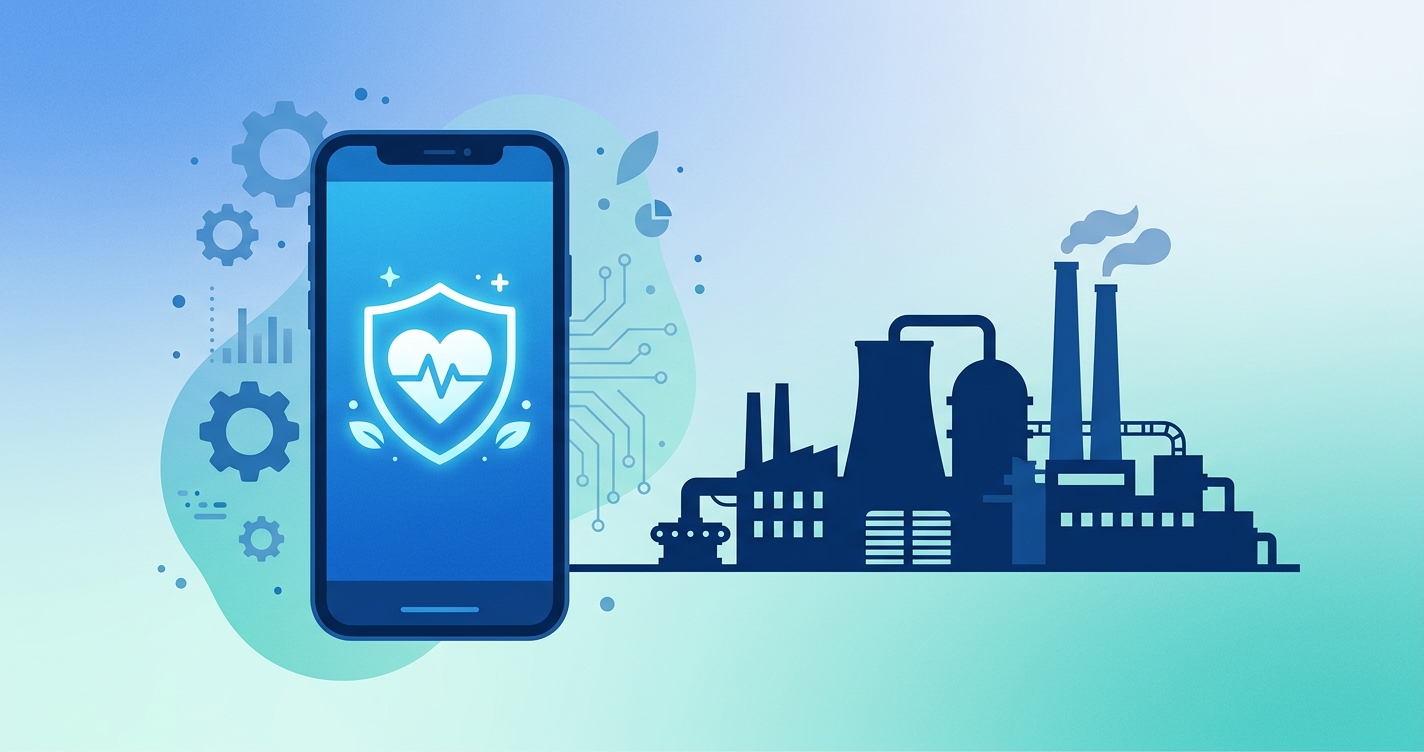
Digital wellness for manufacturing workers has been an afterthought for most employers, and the data backs that up. According to a 2025 Rippl State of the Deskless Workforce report, fewer than 1 in 10 frontline employees have the right technology tools to stay connected to their wider business — let alone tools designed to support their health. Meanwhile, wellness programs keep getting built around office workers, email inboxes, and lunch-hour seminars that factory floor employees will never attend.
Manufacturing employs roughly 13 million workers in the U.S. alone. These are people running 12-hour rotating shifts, working in environments where pulling out a laptop is impractical, and dealing with physical strain that desk workers never encounter. The wellness industry has spent years optimizing for the wrong population.
"About 1 in 12 manufacturing workers suffers from insomnia or anxiety, often exacerbating fatigue and increasing injury risk. Stress and exhaustion heighten the risk of accidents on the shop floor, with studies showing mental distraction is a contributing factor in a significant proportion of workplace injuries." — Meditopia Occupational Wellness Research, 2024
Why Most Wellness Programs Fail Manufacturing Workers
The problem isn't that manufacturing employers don't care about wellness. Many of them do. The problem is that the tools and delivery methods assume a desk-based worker who checks email, browses an intranet portal during breaks, and can attend a webinar at 2 PM on a Tuesday.
None of that maps to life on a production floor.
A plant worker on second shift clocks in at 3 PM and leaves at 3 AM. They don't have a company email address. Their "break" is 20 minutes in a break room with a vending machine and a TV mounted on the wall. If the wellness program lives on a desktop portal that requires SSO authentication through the company network, that worker will never see it.
The Employee Benefit Research Institute's 2024 Workplace Wellness Survey found that concerns about well-being are trending downward overall, but the survey itself acknowledges a persistent gap: workers without regular computer access report significantly lower awareness of available wellness resources. They're not declining to participate. They don't know the programs exist.
The Shift Work Problem
Shift schedules create a layer of complexity that most wellness vendors haven't figured out. Biometric screening events — the kind where a vendor sets up tables in the cafeteria for a week — miss everyone who isn't working day shift that week. A Chapman Institute analysis of heavy manufacturing wellness strategies in 2024 highlighted that traditional onsite wellness events reach, at best, 40% to 50% of the total manufacturing workforce at a given facility. The rest fall through the cracks because of scheduling conflicts.
Annual health fairs compound the problem. If the screening event happens during one particular week and a worker is on nights, on PTO, or on a different rotation, they miss the entire thing. One shot per year, and it's gone.
Language and Literacy Barriers
Manufacturing workforces are among the most linguistically diverse in any industry. According to Bureau of Labor Statistics data, approximately 26% of manufacturing production workers in the U.S. speak a language other than English at home. Wellness programs built around English-only health risk assessments and text-heavy educational content systematically exclude a quarter of the workforce before they even launch.
What Digital Wellness Looks Like When It's Built for Manufacturing
The term "digital wellness" gets used loosely. For manufacturing, it has to mean something specific: health engagement tools that work on a personal smartphone, don't require a corporate email, function across all shifts, and deliver value in under five minutes.
| Feature | Traditional Wellness Program | Digital Wellness for Manufacturing |
|---|---|---|
| Access method | Desktop portal with SSO | Mobile app, no corporate email needed |
| Screening availability | Annual onsite event (1 week) | On-demand, any time, any shift |
| Language support | English only or limited translation | Multi-language by default |
| Time required | 30-60 min for biometric event | Under 5 minutes per engagement |
| Shift compatibility | Day shift only events | 24/7 availability |
| Device requirement | Company computer or onsite kiosk | Personal smartphone |
| Data entry | Paper forms or desktop portals | Camera-based scanning, minimal typing |
| Participation tracking | Manual spreadsheets | Automated, real-time dashboards |
The shift from annual onsite events to always-available mobile tools isn't just a convenience upgrade. It changes who can participate. A second-shift worker in a packaging facility can do a quick health check at 11 PM during break, using the same phone they use for everything else. Nobody has to schedule around their rotation.
Camera-Based Health Screening
One of the more practical developments in this space is camera-based biometric screening. Instead of requiring a blood draw, a cuff, or a dedicated screening station with trained staff, newer approaches use a smartphone camera to capture vital signs — heart rate, respiratory rate, blood oxygen, stress indicators — through a short face scan.
For manufacturing, this solves several problems at once. There's no equipment to ship to remote plant locations. There's no scheduling a vendor to come onsite. Workers scan when it's convenient for them, on their own device, during a break or before their shift starts.
Meeting Workers Where They Already Are
The Meditopia wellness research on manufacturing professionals emphasizes two design principles that keep showing up across effective programs: mobile-first design and anonymous engagement. Manufacturing workers are less likely to engage with wellness tools if participation is visible to supervisors or requires identifying themselves through corporate systems. Programs that allow anonymous health checks, private results, and voluntary engagement consistently outperform those tied to HR platforms.
BCG's 2024 research on deskless workers reinforced this finding from a different angle. Their survey found that deskless workers across industries want technology that respects their autonomy — tools they choose to use, not tools pushed on them through compliance requirements. In manufacturing specifically, the gap between "available" and "used" is largest when programs feel like management surveillance.
The Cost of Doing Nothing
Manufacturing has some of the highest workers' compensation costs and injury rates of any sector. The Bureau of Labor Statistics reports that manufacturing accounts for roughly 15% of all nonfatal workplace injuries requiring days away from work, despite representing about 8% of total employment.
There's a connection between unaddressed health risks and workplace safety that doesn't get enough attention. A worker running on four hours of sleep, dealing with untreated hypertension, or pushing through chronic back pain isn't just an employee with a health problem. They're an elevated safety risk, operating heavy machinery or moving through environments where a lapse in attention has real consequences.
The National Safety Council estimates that fatigue-related productivity losses cost employers approximately $1,967 per employee per year. In manufacturing, where the physical demands are higher and the margin for error is lower, that number likely understates the true impact.
| Health Risk Factor | Prevalence in Manufacturing Workers | Impact on Safety/Productivity | Estimated Annual Cost per Affected Worker |
|---|---|---|---|
| Sleep disorders / fatigue | ~8% (insomnia/anxiety, per Meditopia data) | Increased accident risk, slower reaction times | $1,967 (NSC fatigue estimate) |
| Musculoskeletal disorders | Leading cause of manufacturing injury | Lost workdays, workers' comp claims | $15,000–$30,000 per incident |
| Unmanaged hypertension | ~30% of adult population (CDC) | Cardiac events, chronic absenteeism | $2,000–$4,000 in excess healthcare costs |
| Mental health / stress | 1 in 12 manufacturing workers (Meditopia) | Distraction, error rates, turnover | $3,400 per employee (APA estimate) |
The math on prevention versus treatment isn't complicated. A digital wellness program that catches elevated blood pressure through a five-minute phone scan costs a fraction of an ER visit for a hypertensive crisis on the shop floor.
Current Research and Evidence
The evidence base for digital wellness programs is growing, though research specific to manufacturing populations remains thinner than the industry needs.
A 2025 meta-review published in PMC examined digital wellness programs across workplace settings and found that digital delivery significantly improved accessibility and scalability compared to traditional approaches. The review noted that the strongest outcomes came from programs offering multiple engagement channels — not just one app or one portal, but a combination of tools that workers could access however worked best for their situation.
Dr. Ron Goetzel at Johns Hopkins Bloomberg School of Public Health has published extensively on the connection between wellness program design and outcomes. His work in the American Journal of Health Promotion consistently shows that the largest predictor of program ROI isn't the sophistication of the intervention — it's participation rates. Programs that reach more of the eligible population produce better aggregate outcomes, almost regardless of what the program actually does. For manufacturing, this finding carries an obvious implication: if your program only reaches desk workers, your ROI calculations are built on a fraction of the population.
The Deloitte 2025 Smart Manufacturing and Operations Survey surfaced a related finding that rarely gets connected to wellness discussions. Forty-eight percent of manufacturing respondents reported moderate to significant challenges filling production and operations roles. In a tight labor market, wellness programs are becoming a retention tool. Employees who feel supported are less likely to leave, and in manufacturing, turnover costs are amplified by the training time required for specialized roles.
The Future of Digital Wellness in Manufacturing
The trajectory here is fairly clear. Smartphone penetration among manufacturing workers is high — nearly universal among workers under 45. The hardware barrier is gone. What remains is the software and program design barrier: building tools that are actually useful for people who work with their hands, stand on their feet, and don't have a cubicle to retreat to.
Camera-based health scanning is one piece of this. Platforms like Circadify are developing contactless vital sign measurement through smartphone cameras, which maps well to manufacturing use cases where equipment-free, fast health checks fit the workflow constraints.
The bigger shift is philosophical. Wellness programs have been built top-down — designed by HR for HR's reporting needs, deployed through corporate infrastructure, measured by aggregate participation numbers. Manufacturing workers need programs built from their daily reality outward. Short interactions. No corporate login. Available at 2 AM. Results that stay private.
Employers who figure this out first will have an advantage in a labor market where manufacturing workers have more choices than they've had in decades.
Frequently Asked Questions
How do you run a wellness program for workers without company email?
Mobile-first platforms that use phone numbers or simple access codes instead of corporate SSO solve this. Workers download an app or scan a QR code posted in the break room. No email required, no IT department involvement for onboarding.
What's the participation rate difference between digital and traditional wellness programs in manufacturing?
Traditional onsite biometric events typically reach 40% to 50% of manufacturing workers at a given site, primarily because of shift conflicts. Digital programs with 24/7 mobile access have reported participation rates 20% to 35% higher, though results vary significantly based on program design and incentive structures.
Are camera-based health screenings accurate enough for workplace wellness?
Camera-based screening using rPPG technology captures vital signs through facial blood flow analysis. The technology has been studied extensively in peer-reviewed research, with published studies showing strong correlation with traditional measurement methods for metrics like heart rate and respiratory rate. For wellness screening purposes — identifying trends and flagging potential risks for follow-up — the accuracy is well within useful range.
How do manufacturing employers handle health data privacy for digital wellness?
HIPAA applies to wellness program data regardless of delivery method. Digital platforms typically maintain separate data environments from employer HR systems, with workers receiving individual results that are not shared with managers or supervisors. Aggregate, de-identified data is what flows to employers for program evaluation. Workers should always understand what data is collected and who can see it.