Employer Health Assessment Technology: What It Measures
A research view of employer health assessment technology: the vitals, biometrics, and risk indicators it captures and how results shape wellness program design.
Most benefits teams inherited a screening model built for a different decade. The annual biometric event assumed employees worked in one building, could fast before a morning blood draw, and would line up at a folding table for a finger stick. That assumption no longer holds for a distributed, deskless, and time-pressed workforce, and it has pushed employers to ask a more basic question: what does a modern health assessment actually need to capture, and how should those numbers translate into program decisions? Employer health assessment technology now spans contactless vital sign capture, structured questionnaires, and lab-grade panels, and the value sits less in any single reading than in how the combined data set guides where wellness dollars go.
Health risk assessments are offered by 56% of large firms and biometric screenings by 44%, yet 26% of employers report scaling back spending on onsite screening events, according to 2024 employer benefits survey data summarized by the Melita Group.
That tension, broad adoption alongside retreat from the old delivery model, is the backdrop for every conversation a wellness consultant is now having.
What employer health assessment technology actually measures
Employer health assessment technology is best understood as three connected data layers rather than one product. The first is objective biometrics: physiological readings taken from the body. The second is self-reported risk data gathered through a health risk assessment questionnaire. The third is the derived layer, where algorithms combine the first two into risk scores, population segments, and cohort flags that a program can act on.
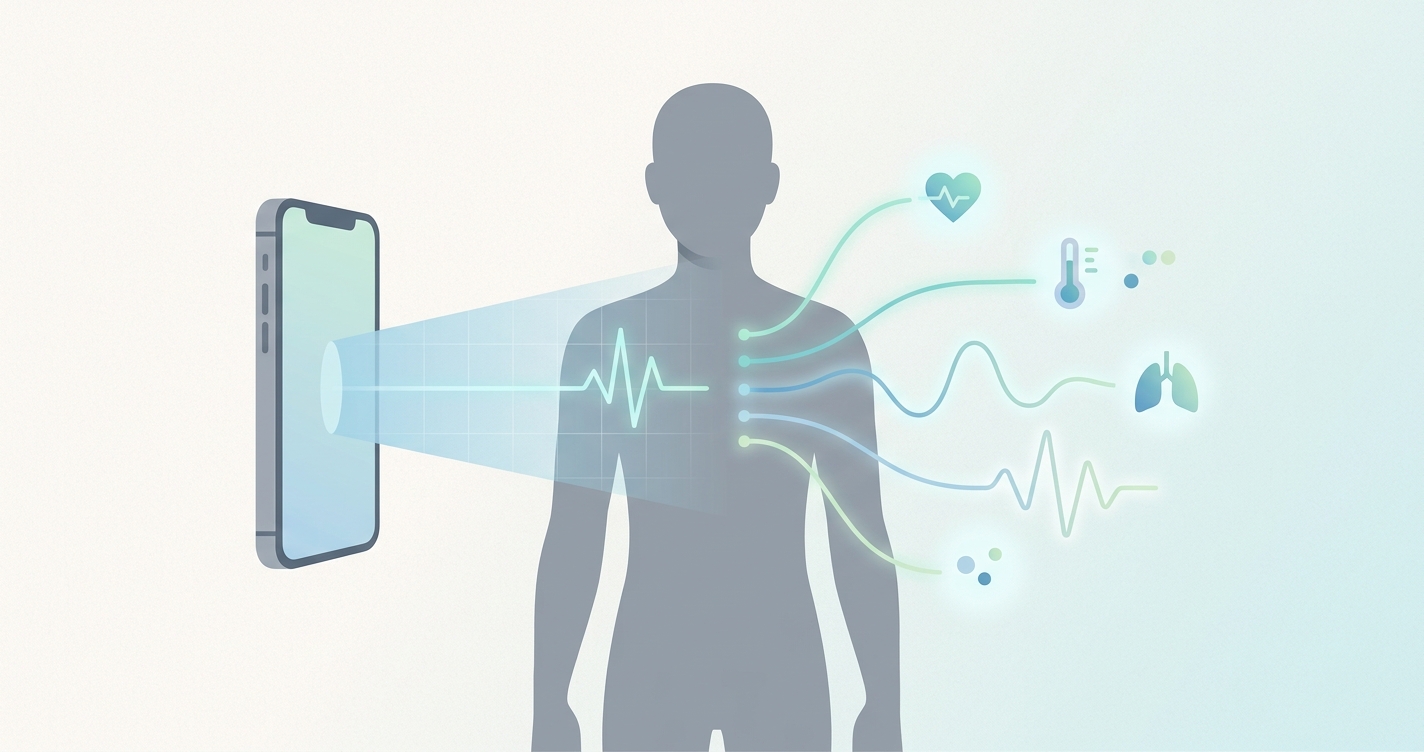
On the biometric side, the metrics employers care about have stayed remarkably consistent even as the capture method changed. The standard panel includes blood pressure, total cholesterol with HDL and LDL breakdown, triglycerides, fasting or non-fasting glucose, body mass index, and waist circumference. What has changed is that several of these can now be estimated from a smartphone camera using remote photoplethysmography, or rPPG, which reads subtle color changes in facial skin tied to the cardiac cycle. A 2024 review of PPG-based vital sign measurement using smartphone cameras, published on ResearchGate, reported error rates under 5% for heart rate and under 10% for blood pressure under controlled conditions, though accuracy varies with movement, lighting, and skin tone.
The health risk assessment layer captures what no camera can see: family history, smoking and alcohol use, physical activity, sleep, diet, stress, medication adherence, and mental health indicators. This self-reported context is what turns a single blood pressure reading into a usable risk picture, and it is the layer regulators treat most carefully under the ADA's voluntariness requirements.
Objective vitals and biometrics
- Cardiovascular indicators: resting heart rate, systolic and diastolic blood pressure, and in some platforms heart rate variability and estimated SpO2.
- Metabolic markers: glucose, HbA1c where lab-connected, and lipid panel components.
- Body composition: BMI, waist-to-height ratio, and body fat estimates.
- Respiratory signals: respiratory rate, increasingly captured contactlessly.
Self-reported risk indicators
- Lifestyle factors: tobacco, alcohol, nutrition, and exercise frequency.
- Behavioral and mental health: stress, sleep quality, and validated depression or anxiety screens.
- Medical and family history: chronic conditions, medications, and hereditary risk.
- Readiness to change: a predictor of who will actually engage with an intervention.
Comparing assessment methods
The choice of capture method shapes participation, cost, and the kind of data a program can rely on. The comparison below frames the tradeoffs employers weigh most often.
| Dimension | Onsite event screening | Lab-based / at-home kit | Contactless smartphone assessment |
|---|---|---|---|
| Core metrics | Full biometric + blood draw | Full lab panel | Vitals via rPPG + HRA questionnaire |
| Blood-based labs | Yes | Yes | No (estimated vitals only) |
| Participation friction | High (scheduling, travel) | Medium (kit return rates) | Low (scan from phone) |
| Reaches deskless / remote | Poor | Moderate | Strong |
| Per-employee cost | Highest | Medium | Lowest |
| Speed to results | Days to weeks | Days | Minutes |
| Best fit | Clinical-grade lab needs | Cholesterol/glucose precision | Broad reach and engagement |
No single column wins outright. The practical pattern emerging across program designs is a tiered model: a low-friction contactless assessment to maximize reach and engagement, with lab-based confirmation reserved for employees whose initial readings or risk scores warrant it.
Industry Applications
Population health and program targeting
The aggregate, de-identified output of an assessment program tells a wellness director where the population actually sits. If 30% of a workforce flags for elevated blood pressure but only 8% for glucose risk, a cardiovascular-focused program design returns more than a generic step challenge. Employee health metrics gathered at scale let teams allocate budget toward the conditions that drive their specific claims spend rather than industry averages.
Incentive and benefits design
Many employers tie a premium differential or HSA contribution to assessment completion. The technology layer matters here because incentive structures must stay compliant and voluntary, and because completion rates depend heavily on friction. A workplace health data program that takes minutes from a phone tends to clear participation thresholds that a scheduled onsite event never reaches, particularly among hourly and remote staff.
Early risk identification and referral
The most defensible use of assessment data is routing. When a reading falls outside normal range, a well-designed program does not diagnose; it nudges the employee toward a primary care visit, a disease management program, or a telehealth consult. The assessment becomes the front door to care rather than the care itself.
Current research and evidence
The evidence base for contactless capture is maturing quickly, and it is honest about limits. A 2024 clinical validation study of rPPG-enabled contactless pulse rate monitoring in cardiovascular disease patients, published in PMC, reported strong agreement with ECG, with a mean absolute error of roughly 1.06 bpm and a Pearson correlation of 0.962. Heart rate, in other words, is close to a solved problem on camera.
Blood pressure is more nuanced. A February 2024 algorithm development study in the preoperative setting, published in PMC, found rPPG tended to underestimate at lower pressures and overestimate at higher ones, a pattern researchers continue to correct for. A July 2025 validation reported excellent accuracy for heart rate at roughly 99% and SpO2 at 93%, but more moderate accuracy for systolic and diastolic blood pressure. The WellFie application study published via medRxiv reported systolic and diastolic accuracies in the low-to-mid 90% range for normotensive adults, with respiratory rate trailing at around 84%.
The research consensus for wellness applications is consistent: contactless vitals are well suited to population-level screening and engagement, and weakest where clinical precision on a single individual is required. That maps cleanly onto how employers should deploy the technology, as a wide net rather than a diagnostic instrument. Google Research, in work toward passive heart health monitoring via smartphone camera, has also emphasized accuracy across all skin tones in real-world conditions as the next benchmark the field must clear.
The future of employer health assessment technology
Three shifts are likely to define the next few years. First, longitudinal data replaces the annual snapshot. When an assessment takes minutes from a phone, employers can measure quarterly trends instead of one yearly point, which is what behavior change programs actually need to demonstrate movement. Second, the assessment layer integrates directly with benefits administration and navigation platforms, so a flagged risk routes automatically to the right program without manual handoffs. Third, regulatory and privacy expectations tighten, pushing vendors toward clear consent, de-identified employer reporting, and strict separation between individual results and anyone in the management chain.
The common thread is that employer health assessment technology is moving from a once-a-year compliance ritual toward a continuous data input for program design. The employers that benefit most will be the ones who treat assessment output as a planning tool, not a box to check.
Frequently asked questions
What does employer health assessment technology measure that a basic survey does not? A survey captures only self-reported behavior and history. Assessment technology adds objective biometrics such as blood pressure, heart rate, cholesterol, glucose, and BMI, then combines them with self-reported data into risk scores. The objective layer is what lets a program verify and prioritize rather than rely on memory and honesty alone.
How accurate are smartphone-based health assessments compared to clinical screening? For heart rate, validation studies show error within about 1 to 2 bpm of ECG. Blood pressure estimates are less precise and tend to drift at the extremes, which is why contactless assessments are best used for population screening and engagement, with lab confirmation reserved for flagged cases.
Can managers see individual employee health results? No. Compliant programs separate individual data from employers entirely. Wellness directors and consultants receive aggregate, de-identified reports that show population trends, never an identifiable employee's readings, consistent with ADA and HIPAA expectations.
How do assessment results actually guide program design? Aggregate results reveal which risks dominate a specific workforce, allowing budget to target the conditions driving claims rather than generic offerings. Individual results trigger private routing to care, disease management, or telehealth without exposing data to the employer.
Circadify is building in this space, helping employers replace expensive onsite events with assessments employees can complete from their own phones while keeping individual data private and program reporting aggregate. To see how contactless assessment can reshape your screening strategy, book an enterprise wellness demo and walk through your population goals with the team.