Can I really check my heart health with just my phone, without a doctor?
A research look at mobile health screening accuracy: what phone-based heart checks can and cannot do, and what wellness directors should expect.
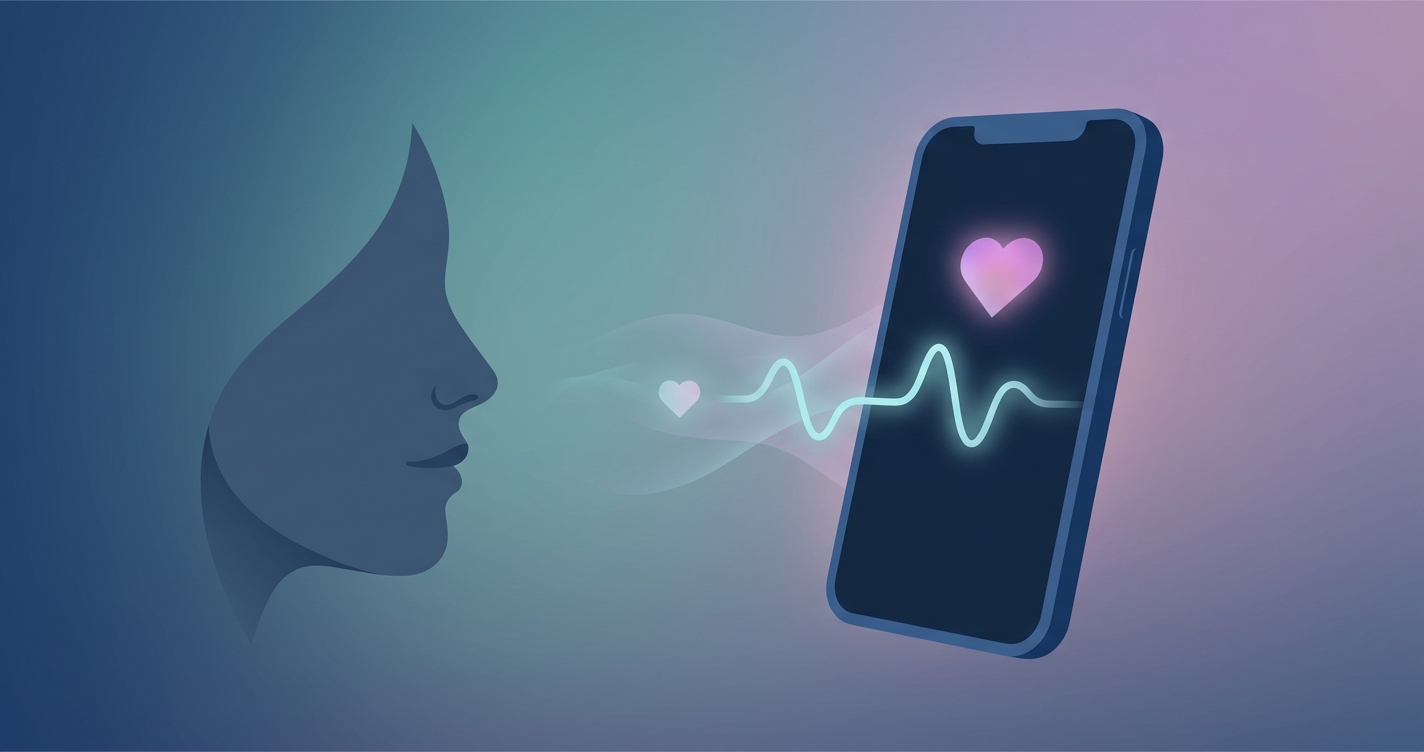
The short version is yes, your phone can read meaningful signals about your heart, but the honest version comes with limits that matter to anyone deciding whether to put this technology in front of thousands of employees. Skepticism is the correct starting point. A camera that estimates your pulse and blood pressure from a 30-second selfie sounds closer to a magic trick than a medical instrument, and the question of mobile health screening accuracy deserves a careful, evidence-based answer rather than a marketing one. For corporate wellness directors weighing whether to replace or supplement traditional onsite events, the useful frame is not "does it work" but "how well does it work, for what, and under what conditions."
A 2025 validation study of a non-contact photoplethysmography mobile application reported 99.1% accuracy for heart rate, while systolic blood pressure estimates landed near 61.3% and diastolic near 56.0%, published in the National Library of Medicine archive as a potential wellness monitoring tool.
That single statistic captures the whole story. Phone-based screening is excellent at some things, moderate at others, and not a substitute for diagnosis. Understanding where each measurement sits on that spectrum is the difference between a credible wellness program and an overpromised one.
What mobile health screening accuracy actually means
The technology behind a phone heart check is photoplethysmography, or PPG. When you place a finger over the camera, or look into the front lens, the phone detects tiny color changes in your skin caused by blood moving through capillaries with each heartbeat. A contact method uses the rear camera and flash on a fingertip. A contactless method, called remote photoplethysmography or rPPG, reads the same pulse signal from facial video. Both approaches feed the raw signal into algorithms that estimate heart rate, heart rhythm, and in some products, blood pressure and oxygen saturation.
Mobile health screening accuracy is highest for heart rate and rhythm. A scoping review of contact-based smartphone PPG compared against electrocardiography found resting heart rate measurement reliable enough for general monitoring when the recording is done correctly. Real-world validation work published in EP Europace through Oxford Academic showed smartphone PPG could detect atrial fibrillation with strong sensitivity and specificity outside the lab.
Blood pressure is where claims get softer. Estimating blood pressure from an optical signal alone, without a cuff, remains an active research problem. Systematic reviews of smartphone-only blood pressure methods consistently describe results as promising for trend awareness rather than precise for diagnosis. That distinction is the one wellness teams most often miss when evaluating vendors.
| Measurement | Phone-based accuracy | Best use in a wellness program | Replaces clinical test? |
|---|---|---|---|
| Resting heart rate | High (often near ECG under good conditions) | Baseline screening, engagement, trend tracking | No, but close for general wellness |
| Heart rhythm / AFib screening | High sensitivity in real-world studies | Early flag for follow-up | No, prompts referral |
| Blood pressure (systolic) | Moderate, variable across studies | Awareness and population trends | No |
| Blood pressure (diastolic) | Lower than systolic in several studies | Awareness only | No |
| Oxygen saturation | Moderate, condition dependent | General wellness context | No |
The practical takeaway is that a phone check is a screening and engagement tool, not a diagnostic device. It is built to surface who might benefit from a conversation with a clinician, not to deliver a verdict.
Where conditions change the answer
Accuracy is not a fixed number. It moves with the environment, the user, and the device. Several factors consistently affect results:
- Motion. Holding still matters. Movement during capture introduces artifacts that degrade the pulse signal.
- Heart rate range. Estimates are most reliable at resting rates and less reliable when the heart rate is elevated.
- Skin tone. PPG signal strength can vary across skin tones, and researchers have flagged the need for better performance across diverse populations.
- Lighting and camera quality. Contactless facial readings depend on adequate, even light and a capable sensor.
- User technique. Clear on-screen guidance and a quiet 30 seconds produce far better data than a rushed, distracted scan.
For an employer population spanning office workers, deskless staff, and a wide demographic range, these variables are not edge cases. They are the everyday operating conditions a program has to design around.
Industry applications for corporate wellness
Replacing or extending onsite events
Traditional biometric events require a venue, phlebotomists, scheduling, and a day of lost productivity, and they still miss remote and deskless employees. A phone-based check removes the logistics and reaches people where they are. The value proposition is access and participation, not lab-grade precision. A program that screens 70 percent of a workforce with a good-enough tool will often surface more actionable risk than one that screens 25 percent with a perfect one.
Engagement and behavior change
Heart rate and rhythm readings give employees an immediate, personal data point. That immediacy is what drives repeat use and conversation. When the goal is to nudge someone toward a clinician visit, a primary care referral, or a lifestyle program, a directional reading is enough to start the right action.
Population-level trend monitoring
Aggregated, de-identified results help benefits teams see where risk concentrates across a workforce and target resources accordingly. Here, the moderate accuracy of blood pressure estimation is far less of a problem, because trends across thousands of readings smooth out individual measurement noise.
Current research and evidence
The literature is moving fast and is candid about both strengths and gaps. A 2024 study led by Bhargav Acharya with William Saakyan, Barbara Hammer, and Hanna Drimalla at Bielefeld University, published in npj Digital Medicine, examined how well rPPG holds up outside controlled settings. The team found that accuracy dropped sharply at elevated heart rates, while low lighting had surprisingly little effect on automated measurements. Their conclusion was that more robust methods are needed before contactless monitoring is dependable for every real-life scenario.
Daniele Di Lernia and colleagues, in an October 2024 paper, tested rPPG "in the wild" using ordinary online webcams in uncontrolled conditions, reinforcing that real-world performance can differ from lab benchmarks. On the heart rate side, the scoping review of contact-based smartphone PPG versus electrocardiography concluded that resting measurements are valid when capture is done well, and offered a checklist for optimal acquisition.
The pattern across these studies is consistent. Heart rate and rhythm detection are mature enough for general wellness screening. Cuffless blood pressure is improving but still better suited to awareness than diagnosis. And capture conditions, not just algorithms, drive real-world accuracy.
The future of mobile health screening accuracy
The next several years point toward steady gains rather than a single breakthrough. Three directions stand out. First, larger and more diverse validation datasets are addressing the skin tone and demographic performance gaps that current research openly names. Second, algorithms are getting better at rejecting motion and poor-lighting artifacts, which narrows the gap between lab and real-world numbers. Third, calibration approaches that pair an occasional cuff reading with ongoing optical estimates may improve blood pressure reliability for individuals over time.
For employers, the strategic implication is to choose tools that are transparent about what they measure well today and that publish or reference real validation, while building programs that treat phone screening as a front door to care rather than a replacement for it. The technology is good enough now to drive participation and early flags at a scale onsite events never could, and it is improving on exactly the dimensions that matter most.
Frequently asked questions
Can a phone really measure my heart rate accurately? For resting heart rate, yes. Multiple studies comparing smartphone PPG to electrocardiography found it reliable for general monitoring when the reading is taken correctly, with stillness and adequate lighting. Accuracy declines at elevated heart rates and with motion.
Is phone-based blood pressure as accurate as a cuff? No. Cuffless blood pressure from a phone is best treated as awareness and trend information, not a diagnostic reading. Published studies show systolic estimates outperform diastolic, but both fall short of a validated cuff for clinical decisions.
Does this replace seeing a doctor? No. Mobile screening is designed to surface signals worth following up, such as an irregular rhythm or an elevated trend, and to point employees toward appropriate clinical care. It is a screening and engagement layer, not a diagnosis.
Why would a wellness program use it if it is not perfectly accurate? Because reach and participation often matter more than lab precision for population health. A tool that screens far more of a workforce, including remote and deskless staff, can surface more actionable risk than a precise method most employees never use.
Circadify is building in exactly this space, focused on making credible phone-based screening practical at employer scale without the cost and logistics of onsite events. To see how a phone-first approach fits a corporate wellness program, request an enterprise wellness demo.