
Phone-Based Health Screening vs Lab Bloodwork: What's the Difference?
A research-grounded comparison of phone-based health screening vs lab bloodwork on accuracy, speed, employee experience, and cost for wellness programs.
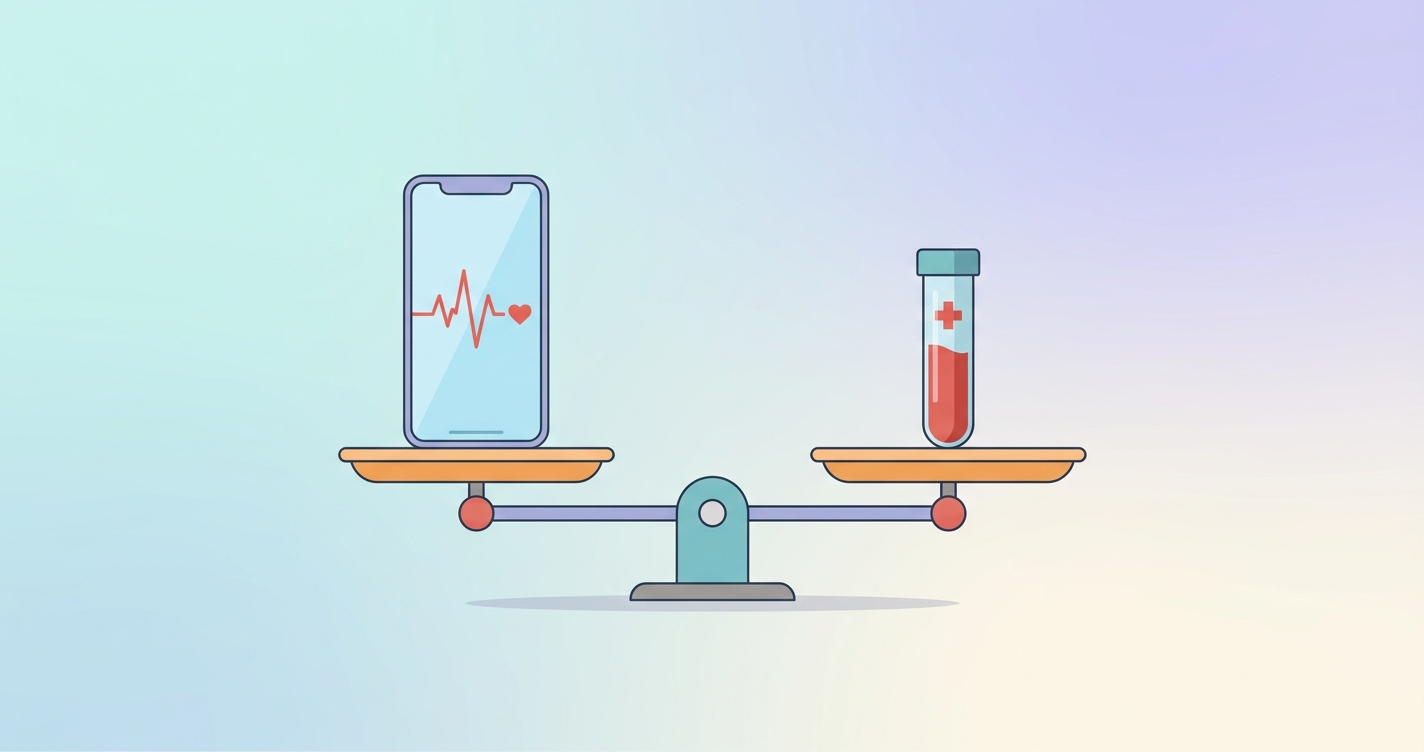
Benefits teams evaluating screening vendors in 2026 are no longer choosing between two lab providers. They are choosing between two fundamentally different data collection models: a venous blood draw analyzed in a certified laboratory, and a 30- to 60-second camera scan processed on a smartphone. The question of phone-based health screening vs lab bloodwork has moved from a fringe curiosity to a line item in procurement decks, largely because participation in traditional onsite events keeps disappointing the people who pay for them. Understanding what each method actually measures, how reliable each measurement is, and what it costs in dollars and employee time is now a core competency for any health consultant advising employers.
Some employers report biometric participation rates of 88 to 99 percent when paired with incentives, yet many programs that rely on appointment-based lab draws struggle to clear half that without sustained pressure. Source: corporate wellness cost and participation analysis, 2025.
Phone-based health screening vs lab bloodwork: how the two models differ
The comparison of phone-based health screening vs lab bloodwork starts with a simple distinction in physics. A laboratory blood test measures analytes directly. A phlebotomist draws venous or capillary blood, and an analyzer quantifies total cholesterol, HDL, LDL, triglycerides, glucose, and HbA1c. These are molecular measurements with decades of standardization behind them.
A camera-based scan measures something different. It uses photoplethysmography (PPG), reading subtle color changes in facial or fingertip skin as blood pulses through capillaries. From that optical signal, software estimates heart rate, blood oxygen saturation, respiratory rate, heart rate variability, and, with more variability, blood pressure. It is an inference engine, not a chemistry analyzer. It does not draw blood, so it does not produce a lipid panel or a fasting glucose value in the way a lab does.
That difference matters for how consultants frame the two options. One is a clinical diagnostic record. The other is a high-frequency wellness signal designed to reach people who would otherwise never engage at all.
| Factor | Phone-based camera screening | Lab bloodwork |
|---|---|---|
| What it measures | Heart rate, HRV, SpO2, respiration, estimated blood pressure, wellness risk indicators | Cholesterol panel, glucose, HbA1c, triglycerides, direct biomarkers |
| Time per employee | 30 to 60 seconds, on demand | 15 to 30 minutes plus travel and scheduling |
| Location | Anywhere with a smartphone | Clinic, lab, or onsite event room |
| Fasting required | No | Often yes |
| Reliability profile | Strong for heart rate and SpO2; moderate and still maturing for blood pressure | Established clinical standard |
| Typical cost per employee | Low marginal cost per scan | Roughly 45 to 75 dollars for basic onsite panels |
| Repeatability | Frequent rescans possible | Usually annual |
| Participation friction | Minimal | High, appointment dependent |
Camera health screening accuracy: what the research actually shows
The most honest answer on camera health screening accuracy is that it varies sharply by metric. Heart rate and oxygen saturation from PPG-based mobile applications have performed well in validation work. Blood pressure is the harder problem, and the literature is candid about it.
A 2024 study by Athaya and colleagues, published on arXiv, analyzed smartphone PPG pulse waveforms across 127 participants and found that despite meaningful correlation with reference devices, the estimates did not satisfy the AAMI and BHS standards that govern clinical blood pressure devices. A separate validation study of a non-contact PPG mobile application, involving 562 participants and indexed in PubMed Central, reported excellent agreement for heart rate and SpO2 but only moderate agreement for systolic and diastolic blood pressure, with mean absolute errors near 14 and 10 mmHg respectively.
The practical reading for a benefits consultant is this:
- Camera scans are strong as engagement and trend tools, weak as a substitute for a diagnostic cuff or a fasting lipid panel.
- The technology is improving quickly, and newer models using pulse transit time and combined sensor inputs are narrowing the gap.
- A scan that flags an elevated reading is best treated as a prompt for follow-up, not a final clinical verdict.
This is why the framing of digital biometric screening vs lab test should never be winner-take-all. The two methods answer different questions for different populations.
Industry Applications
Reaching the disengaged majority
The strongest case for phone-based screening is reach. Onsite events and clinic referrals systematically miss remote workers, deskless staff, multi-site operations, and anyone whose schedule does not bend around a screening window. A scan that runs from a personal phone removes scheduling, travel, and fasting as barriers in one move. For an employer whose lab-based participation has plateaued, the engagement lift is often the entire point.
Annual compliance and clinical baselines
Where a plan design ties a premium differential to a verified lipid or glucose value, lab bloodwork remains the defensible record. Carriers and stop-loss arrangements built around documented biomarkers are not going to accept an inferred reading. For these use cases the lab draw is not optional, and consultants should say so plainly.
Hybrid program design
The most sophisticated employers are not choosing one model. They deploy camera-based scans as the wide top of the funnel, capturing the entire population frequently, then route flagged or higher-risk employees toward confirmatory lab work. This converts the employee health check comparison from an either/or into a tiered system: broad, cheap, frequent screening that identifies who actually needs the expensive, precise test.
Current research and evidence
The evidence base is splitting into two clear conclusions. First, PPG-derived vitals such as heart rate and oxygen saturation have reached a reliability that supports population wellness monitoring, a point reinforced across the 2024 and 2025 validation studies cited above. Second, cuffless blood pressure estimation is promising but not yet equivalent to a validated cuff, and researchers including Athaya and the JMIR mHealth instrument-validation group continue to call for protocol-specific testing before optical methods displace traditional devices.
On the economics, the data favors digital reach. Industry cost analyses in 2025 placed basic onsite biometric panels at roughly 45 to 75 dollars per employee, before the indirect costs of room rental, nurse staffing, lost work time, and the administrative overhead of scheduling. Peer-reviewed work has also tied biometric screening participation to measurable downstream savings, with one analysis estimating around 291 dollars in reduced medical costs per participant in the following year. The recurring theme is that the value of any screening program is capped by how many people complete it. A clinically perfect test that 40 percent of employees skip generates less population health insight than a good-enough scan that 90 percent complete.
The future of phone-based health screening
Three trends will shape the next several years. Sensor fusion, combining the camera with phone accelerometers and other inputs, is steadily tightening blood pressure estimates. Regulatory pathways for software-based measurement are maturing, which will give employers and carriers clearer standards to evaluate. And the line between screening and continuous monitoring is blurring, as the marginal cost of a scan approaches zero and employees can check vitals weekly rather than annually.
The likely destination is not the disappearance of lab bloodwork. It is a stratified model where camera-based screening becomes the default first touch for the whole workforce, and laboratory testing becomes a targeted, confirmatory step reserved for the people and the plan requirements that genuinely need it. For consultants, the skill shifts from picking a vendor to architecting the handoff between the two.
Frequently asked questions
Can phone-based screening replace lab bloodwork entirely?
Not for biomarkers that require a blood sample, such as cholesterol, glucose, and HbA1c. Camera screening estimates vitals like heart rate, oxygen saturation, and blood pressure from an optical signal. It is best positioned as a high-reach first layer, with lab testing reserved for confirmation and for plan designs that require verified biomarker values.
How reliable is camera health screening for blood pressure?
Heart rate and oxygen saturation from PPG perform well in validation studies. Blood pressure is harder. A 2024 study by Athaya and colleagues found smartphone estimates did not meet clinical AAMI and BHS standards, and a 562-participant study reported only moderate agreement for blood pressure. Treat elevated camera readings as a signal to confirm, not a diagnosis.
Why would an employer choose camera screening over a lab event?
Reach and cost. Onsite and clinic-based draws miss remote and deskless workers and require scheduling, travel, and often fasting. Camera scans run from any smartphone in under a minute, which lifts participation toward the levels needed for meaningful population health data, at a far lower marginal cost per employee.
Is a hybrid model the best approach?
For most employers, yes. Use camera screening to engage the entire workforce frequently and identify risk, then route flagged employees to lab testing for confirmation. This captures the reach advantage of digital screening and the diagnostic precision of bloodwork without paying full lab cost for every employee.
Circadify is building in exactly this space, helping employers replace expensive, low-turnout onsite events with phone-based screening that reaches the whole workforce. To see how a tiered digital model fits your clients' programs, request an Enterprise wellness demo.