Why should I bother with a quick work health scan before my vacation?
How a brief work health scan delivers digital health screening benefits and early detection insights employees can act on before any personal event.
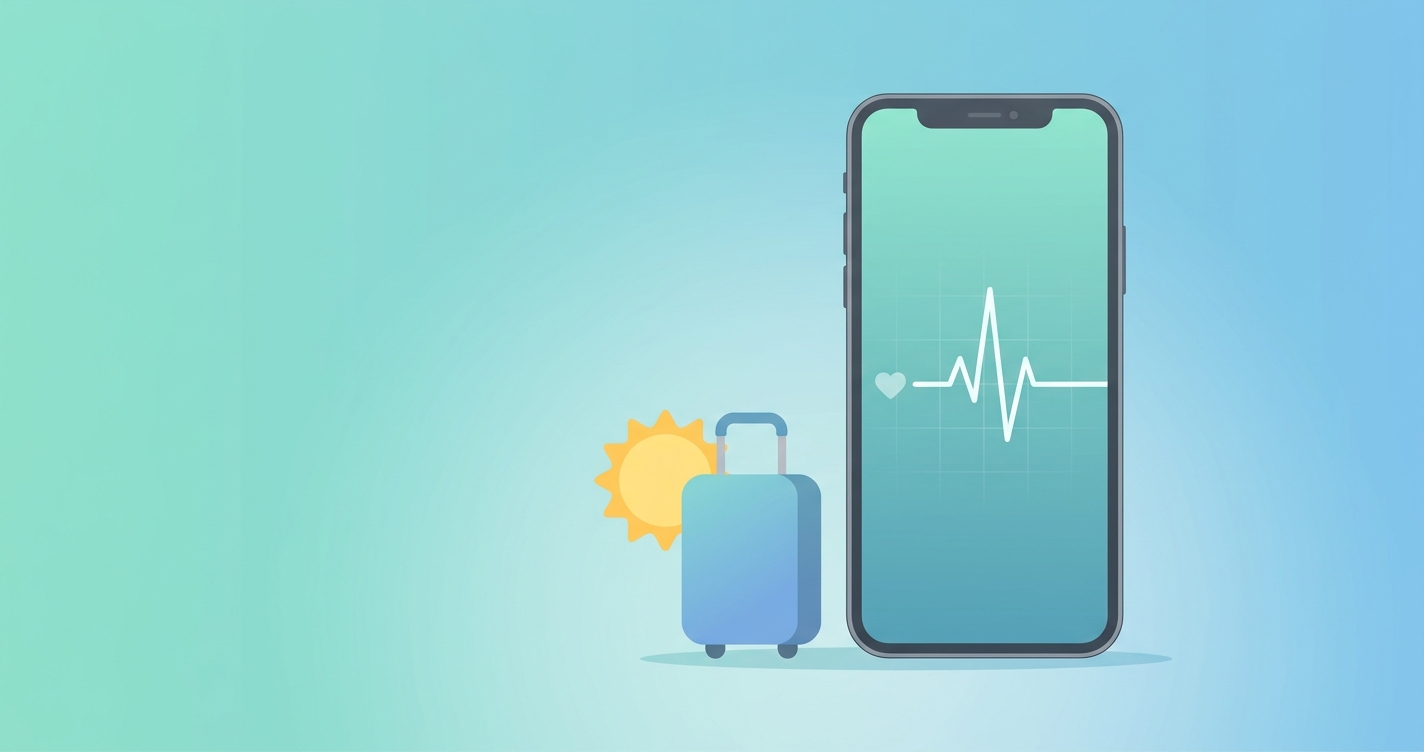
A vacation request and a health scan rarely show up in the same sentence, yet the timing question matters more than most employees assume. When a wellness program offers a 60-second phone-based scan, the natural instinct is to defer it until "after the trip" or "next quarter." That delay is exactly where the value leaks out. The digital health screening benefits most worth capturing are time-sensitive: a blood pressure reading flagged before a long-haul flight, a resting heart rate trend caught before a week of altitude or heat, a baseline measurement taken while you feel fine rather than after something goes wrong. For the consultants and wellness directors who design these programs, the pre-vacation moment is an underused engagement window, not a scheduling inconvenience.
Roughly 41% of U.S. adults with hypertension are unaware they have it, and the share of adults aged 20 to 44 who are unaware rose from 14.6% in 2013-2014 to 17.8% in 2021-2023, according to CDC and Million Hearts data published in 2025.
The digital health screening benefits hiding in a 60-second scan
The case for a quick scan is not that it replaces a physician visit. It does not. The case is that brief, repeatable measurement closes the gap between feeling healthy and actually knowing where your numbers sit. High blood pressure is the clearest example. The CDC reported that 48.1% of U.S. adults (about 119.9 million people) had high blood pressure in 2024, and hypertension was a primary or contributing cause of 680,179 deaths that year. The condition typically produces no symptoms, which is why a person can pass through an entire travel season feeling fine while their cardiovascular risk climbs unnoticed.
A pre-vacation scan reframes screening around a personal event the employee already cares about. Instead of an abstract corporate requirement, it becomes a sensible pre-trip check, the same logic as confirming a passport is valid or refilling a prescription. That framing is what turns the digital health screening benefits from a compliance line item into something employees actually complete. For benefits teams, the behavioral hook matters as much as the measurement itself.
The other underrated benefit is the baseline. A reading taken while rested and at home, before the disruption of travel, gives both the employee and any downstream clinician a clean reference point. If a number looks off later, there is something to compare it against. Without that baseline, a single elevated reading is just noise.
How a quick scan compares to the alternatives
Employees usually weigh three options when a personal event approaches: skip screening entirely, book a traditional appointment, or complete a brief digital scan. The trade-offs are not subtle.
| Factor | Skip it until "later" | Traditional clinic appointment | Quick phone-based work health scan |
|---|---|---|---|
| Time required | Zero now, unknown later | 1 to 3 hours including travel | Under 2 minutes |
| Scheduling friction | None, but rarely happens | Days to weeks of lead time | On demand, any time |
| Captures a pre-event baseline | No | Only if timed perfectly | Yes, before the trip |
| Cost to employee | None | Copay or time off work | Typically employer-covered |
| Likelihood of completion | Low | Moderate | High |
| Surfaces early-warning signals | No | Yes | Yes, as a screening prompt |
The pattern is consistent. The clinic visit is thorough but slow, which is why so many people postpone it past the point of usefulness. Skipping costs nothing today and a great deal later. The quick scan wins on completion rate, and completion is the variable that determines whether a program produces any health insight at all.
Key reasons employees benefit from scanning before a personal event:
- A baseline reading exists before travel stress, diet changes, and disrupted sleep distort the numbers.
- An elevated result becomes an early prompt to see a clinician, not a vacation-ruining surprise.
- The scan fits into existing routines instead of requiring time off.
- Repeat scans build a trend line, which is far more informative than any single measurement.
- Family-history risks become visible early, when lifestyle changes are most effective.
Industry applications for wellness consultants
For the people who build and sell these programs, the pre-event scan is a design pattern worth deliberately engineering rather than leaving to chance.
Timing screening prompts around life events
Engagement data consistently shows that generic, calendar-driven reminders underperform. Tying a scan invitation to a personal milestone, whether a vacation, a new fiscal year, or open enrollment, gives employees a concrete reason to act now. Consultants can recommend automated nudges that fire when an employee submits PTO requests, turning a routine HR workflow into a health-engagement trigger.
Reaching populations that skip clinics
Deskless, remote, and shift-based workers are the groups most likely to miss traditional screening. A phone-based scan removes the conference-room event and the clinic appointment from the equation entirely. The same pre-vacation framing that motivates an office worker also reaches a field technician who would never schedule a separate screening visit.
Building early-detection into existing benefits
Brokers and consultants increasingly need differentiation beyond commodity plan design. A screening tool that produces early-warning signals, then routes flagged employees toward existing telehealth or primary-care benefits, demonstrates measurable program value. The scan becomes the front door to care the employer already pays for but employees underuse.
Current research and evidence
The evidence base for digital screening has matured quickly. A 2025 systematic review of digital health interventions found statistically significant clinical improvements in 79.7% of studies examined, with the majority of measured outcomes being clinical rather than purely behavioral. That matters because skeptics often dismiss app-based tools as engagement gimmicks; the data suggests measurable clinical signal.
On the detection side, the U.S. Preventive Services Task Force continues to recommend blood pressure screening for all adults, reflecting how much undiagnosed hypertension persists across the population. The June 2025 trend analysis from CDC and Million Hearts is the more sobering finding: awareness is moving in the wrong direction, particularly among adults aged 20 to 44, the exact demographic least likely to have an established primary-care relationship and most likely to be in the workforce.
Workplace-specific evidence reinforces the model. CDC's review of workplace health promotion found that screening-based programs can improve blood pressure control and deliver a positive return on investment for employers. The mechanism is straightforward: earlier detection means earlier intervention, and earlier intervention is consistently cheaper than treating advanced disease. Preventive screening research summarized by major payers in 2025 found earlier-stage detection across several conditions translates directly into lower downstream treatment costs.
The honest caveat, repeated across this literature, is that screening only works if people participate and if flagged results actually connect to follow-up care. A scan that nobody completes, or that surfaces a risk nobody acts on, produces no benefit. That is why completion-friendly timing and clear care pathways are not optional extras. They are the difference between a program that works and one that merely exists.
The future of pre-event digital health screening
The direction of travel is toward screening that is continuous, contextual, and quietly embedded in tools people already use. Wearable and phone-based sensors are extending what a brief scan can capture, and AI-assisted analysis is improving how subtle trends get flagged for human review. The 2025 preventive-health forecasts point to risk prediction that draws on repeated measurements rather than one annual snapshot.
For employers, the implication is a shift from the once-a-year health fair toward an always-available screening layer that activates around the moments that matter to each employee. A pre-vacation scan is an early version of that idea: screening that meets people where they already are, at a moment they are already paying attention. As interoperability between screening tools and benefits platforms improves, the flagged result will route to the right care faster, shrinking the gap between detection and action that limits today's programs.
The remaining challenges are real. Data privacy, employee trust, and clear separation between individual results and employer visibility all have to be handled carefully for adoption to hold. Programs that get this right will treat the brief scan not as a data-collection exercise but as a personal benefit the employee owns.
Frequently asked questions
Does a quick work health scan replace seeing a doctor before I travel? No. A scan is a screening tool, not a diagnosis. Its value is surfacing measurements like blood pressure or resting heart rate so you know whether to follow up with a clinician. Think of it as an early prompt, not a verdict.
Why does timing it before a vacation matter? A scan taken while you are rested and at home gives you a clean baseline before travel disrupts sleep, diet, and routine. If something feels off during or after the trip, you have a reference point. It also catches issues while you have time to act.
Will my employer see my individual results? Properly designed programs separate individual health data from the employer and report only aggregate, de-identified trends. Your specific blood pressure or heart rate reading is yours. Always confirm the privacy terms of any specific program before participating.
How often should I scan if I feel healthy? Repeat scans are where the value compounds, because a trend line is far more informative than a single reading. Many programs encourage periodic checks tied to events like travel, enrollment periods, or the start of a new year.
Circadify is building toward exactly this kind of screening layer, replacing one-day onsite events with phone-based scans employees can complete before a trip, during enrollment, or whenever risk awareness matters most. Wellness consultants and benefits teams who want to see how early-detection prompts fit into an employer program can request an enterprise wellness demo to walk through the workflow.