Will my annual health numbers be different if I'm stressed at work?
How job stress shifts blood pressure, cortisol, and other workplace wellness check results, and why consistent monitoring gives wellness directors clearer data.
Most corporate wellness directors treat the annual biometric screening as a fixed snapshot: one number per metric, captured once a year, filed against a benchmark. The trouble is that the human body does not hold still for a calendar. A worker who walks into a screening after a quarter-close, a layoff rumor, or a 6 a.m. commute through traffic will produce different numbers than the same worker on a calm Tuesday. If you have ever wondered whether your annual health numbers shift when you are stressed at work, the research is unambiguous: they do, and the size of that shift matters for how employers read workplace wellness check results.
This is not a fringe concern. Stress is a measurable physiological event, and several of the metrics that anchor a standard screening panel respond to it within minutes. Understanding which numbers move, by how much, and for how long is the difference between a wellness program that flags real risk and one that flags a bad morning.
"Approximately 40% of American workers describe their jobs as very or extremely stressful, and 77% report that work stress has affected their physical health.", Mental Health America and Headspace Workforce State of Mind, 2024
What stress actually does to workplace wellness check results
When a person experiences acute stress, the sympathetic nervous system releases adrenaline and the adrenal glands release cortisol. The immediate effects are well documented: heart rate climbs, blood vessels constrict, and blood pressure rises. None of this is pathological in the moment. It becomes a measurement problem only when it lands inside a once-a-year screening window and gets recorded as a baseline.
The most studied example is blood pressure. The phenomenon known as white coat hypertension, where readings spike in a clinical setting because of situational anxiety, is directly relevant to onsite screening events. Research summarized in the 2023 European Society of Hypertension guidelines and reviewed by groups including Harvard Health notes that office readings can run meaningfully higher than out-of-office readings, and that single measurements are poor at separating true elevation from situational elevation. A conference-room screening table staffed by a stranger with a cuff is, functionally, a white coat setting.
Work stress also shows up in slower-moving and lab-based metrics:
- Blood pressure and heart rate rise acutely and can stay elevated across a stressful workday, as documented in ambulatory blood pressure studies of working adults.
- Cortisol, the primary stress hormone, follows disrupted patterns under chronic occupational stress, which research on shift workers and hospital staff has tied to anxiety and cardiovascular strain.
- Heart rate variability, a marker of autonomic balance, tends to fall under sustained work stress.
- Glucose and lipid readings can drift upward over time when chronic stress drives cortisol elevation, poor sleep, and changed eating patterns.
The key distinction is between acute and chronic stress. Acute stress distorts a single measurement. Chronic stress changes the underlying physiology that the measurement is trying to capture. A good wellness program needs to tell these apart, and a single annual data point cannot.
Acute versus chronic stress: how the numbers compare
The table below summarizes how common screening metrics behave under each type of stress and what that means for interpreting results.
| Metric | Effect of acute stress (screening-day) | Effect of chronic work stress | Interpretation risk for a single annual reading |
|---|---|---|---|
| Blood pressure | Can rise 10-20 mmHg from situational anxiety | Sustained elevation, higher hypertension risk | High: white coat effect mimics true hypertension |
| Resting heart rate | Rises temporarily | Modest sustained increase | Moderate: recovers quickly after the event |
| Cortisol | Spikes within minutes | Dysregulated daily rhythm | High: time of day and stress both matter |
| Heart rate variability | Drops during the stressor | Lower baseline over time | Moderate: rarely on standard panels |
| Fasting glucose | Minor short-term rise | Upward drift with chronic stress | Moderate: confounded by fasting and timing |
| Cholesterol/lipids | Minimal same-day change | Gradual worsening over months | Low day-to-day, meaningful long term |
The pattern is consistent. The metrics most prone to same-day distortion, blood pressure and cortisol, are also among the most prominent in employer screening panels and incentive thresholds. That creates a real possibility of misclassification: an employee tagged as high-risk on a stressful screening day, or reassured as low-risk on a calm one when chronic issues exist.
Industry applications for wellness program design
For benefits leaders and wellness directors, the stress-measurement problem is not academic. It shapes participation, data quality, and the defensibility of any outcomes-based incentive.
Reducing measurement bias in screening
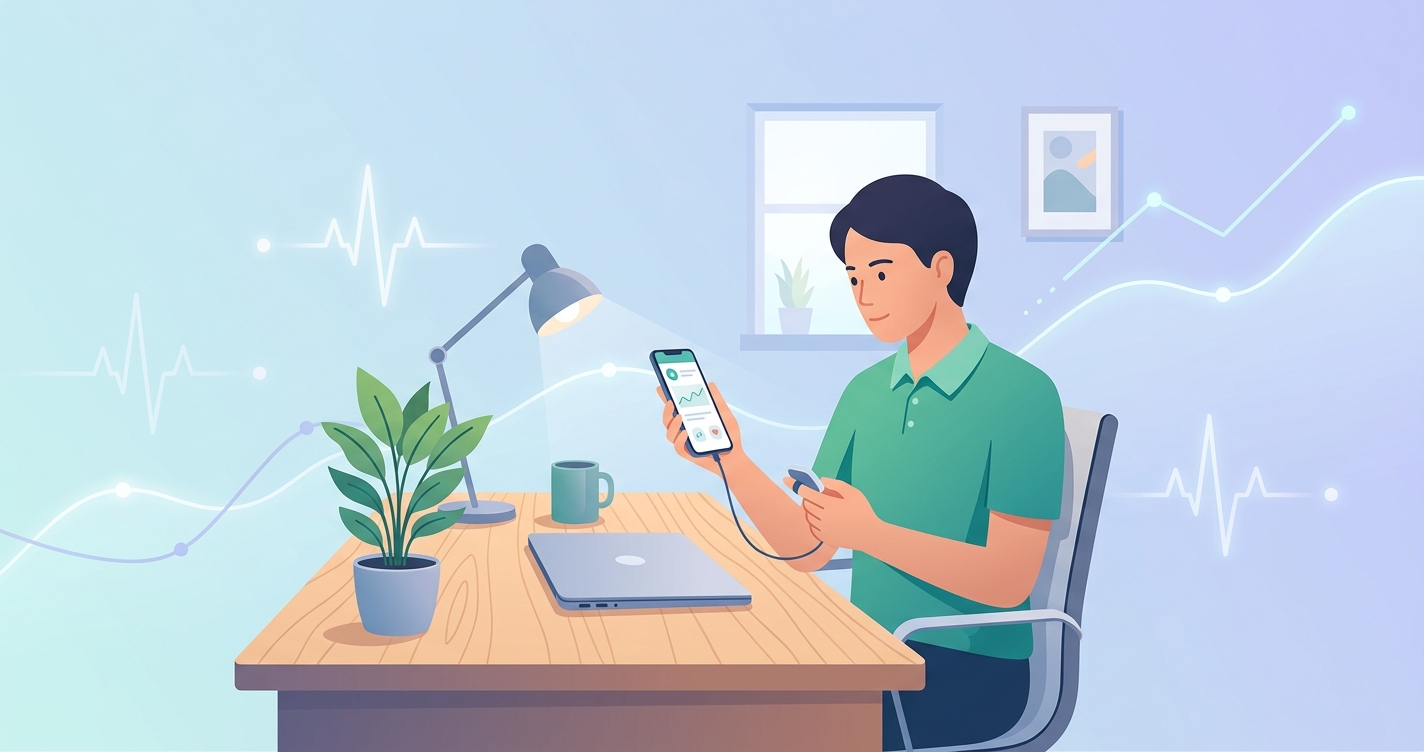
A one-day onsite event concentrates all measurement into the most anxiety-inducing possible context: a queue, a clipboard, an unfamiliar clinician, and coworkers nearby. Distributing measurement across time and letting employees screen in a familiar, low-pressure setting reduces the situational spike that contaminates workplace wellness check results. This is one of the underappreciated advantages of phone-based and at-home models over the conference-room event.
Improving fairness in incentive-linked programs
When wellness incentives are tied to hitting specific biometric targets, a stress-inflated reading can cost an employee a reward they would otherwise earn. That is both an equity problem and a compliance exposure. Programs that allow repeat measurement, trend-based evaluation, or reasonable-alternative standards are better positioned to treat employees fairly and to withstand scrutiny.
Turning stress signals into program insight
Aggregated, de-identified screening data that shows elevated readings clustered around high-stress periods or high-stress departments is genuinely useful. It tells a wellness director where to direct mental health resources, workload interventions, or manager training. A static annual number throws that signal away.
Current research and evidence
The link between work stress and cardiovascular metrics has strong empirical support. A 2024 analysis of the Multi-Ethnic Study of Atherosclerosis, published in the Journal of the American Heart Association and covered by the American Journal of Managed Care, found that adults reporting work-related stress had lower odds of achieving optimal cardiovascular health scores, a composite that includes blood pressure, glucose, and lipids. Work stress, in other words, is not just a feeling that coincides with bad numbers. It tracks with them across a large, diverse population.
On the measurement side, ambulatory blood pressure research on working adults has shown that job strain is associated with higher blood pressure and lower heart rate variability across the workday, not only in the moment of stress. Studies of salivary cortisol in occupational settings, including work on hospital staff and shift workers reviewed in 2024 and 2025, reinforce that occupational stress disrupts the normal cortisol rhythm, which is why a single timed sample is difficult to interpret without context.
The white coat literature adds the final piece. Reviews aligned with the 2023 European Society of Hypertension guidance emphasize that reproducibility of a single elevated office reading is limited and that out-of-office or repeated measurement is needed to confirm true hypertension. For employers, the lesson is direct: one reading taken under stress is a hypothesis, not a diagnosis.
The market has noticed. Analysts tracking workplace stress monitoring tools valued the segment near 0.6 billion dollars in 2024, reflecting employer appetite for continuous, context-aware physiological data rather than annual snapshots.
The future of workplace wellness check results
The direction of travel is away from the single annual event and toward frequent, low-friction measurement that captures trend rather than moment. Several shifts are already underway:
- Repeat and on-demand screening that lets employees measure more than once a year, smoothing out stress-driven outliers.
- Phone-based capture that removes the clinical setting most likely to trigger situational spikes.
- Trend-based risk models that weigh a series of readings over time instead of treating one number as truth.
- Integration of stress and recovery indicators alongside traditional biometrics, giving directors context for why a number moved.
For wellness directors, the practical implication is that data quality and employee fairness improve together when measurement becomes routine rather than rare. A program built around consistent, easy monitoring is both more accurate and more likely to earn employee trust, which in turn raises participation.
Frequently asked questions
Can a stressful day really change my biometric screening results? Yes, for some metrics. Blood pressure and heart rate can rise noticeably from situational stress, and cortisol responds within minutes. These changes are real but often temporary. Lipid and long-term glucose patterns are less affected by a single stressful day, though chronic stress can move them over months.
How can employers tell stress-driven readings from real health risk? The most reliable approach is more than one measurement. Repeat or trend-based screening, plus the option to measure in a low-stress setting, helps separate a one-time spike from a sustained problem. The clinical literature on white coat hypertension supports out-of-office and repeated readings for exactly this reason.
Does this mean annual screenings are useless? No. Annual screenings still surface risk that would otherwise go undetected. The point is that a single yearly reading taken in a high-stress setting is best treated as a starting point, with follow-up and repeat measurement to confirm anything that looks elevated.
Should wellness incentives be tied to a single biometric reading? Tying rewards to one reading raises fairness and compliance concerns, since stress can distort that reading. Programs that allow repeat measurement, trend evaluation, or reasonable alternative standards tend to be both fairer and more defensible.
Circadify is addressing this space by giving employers a way to move past the one-day, high-stress screening event toward consistent, phone-based measurement that employees can complete in a familiar setting. To see how distributed, repeatable screening can improve both data quality and participation, request an enterprise wellness demo.