
Year-Round Wellness vs Annual Screening: Which Drives Better Outcomes?
Comparing year-round wellness programs to annual biometric screening events, with data on participation, health outcomes, and cost impact for employers.
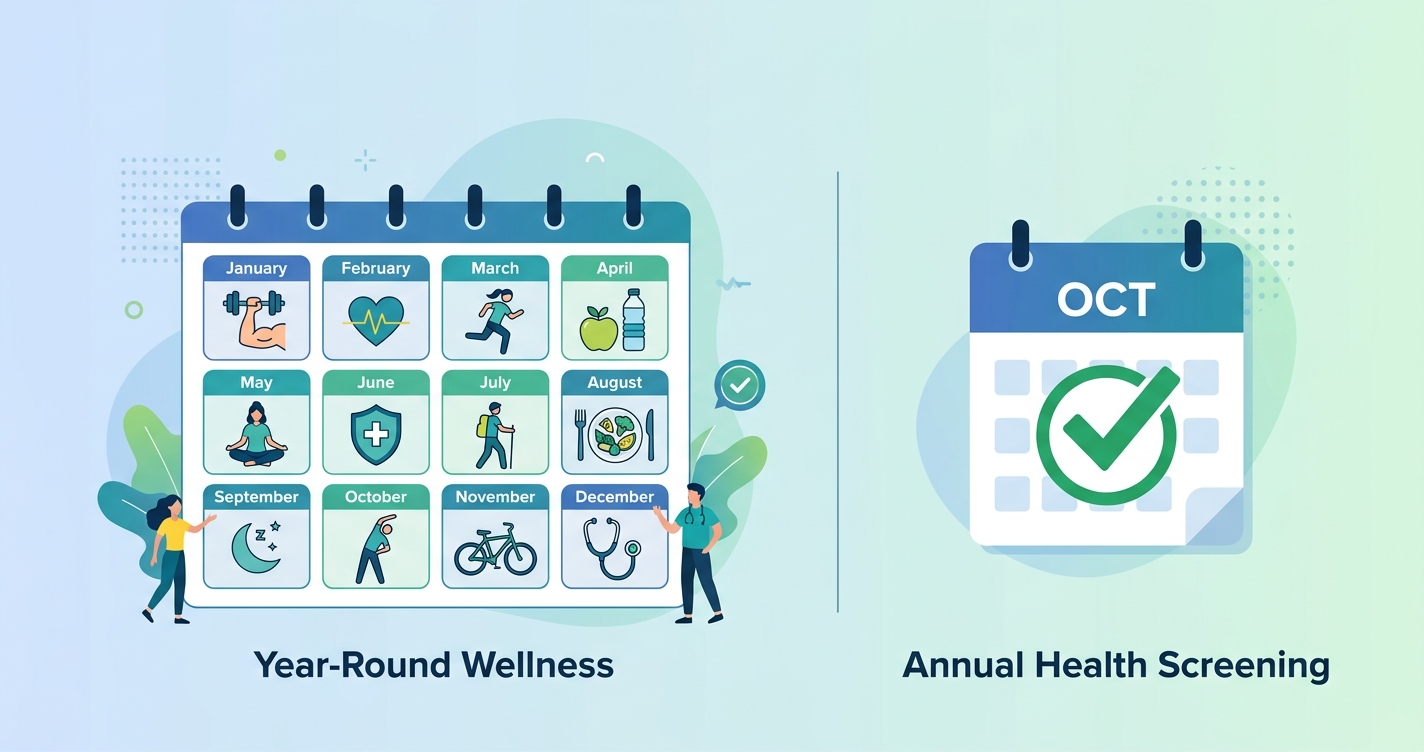
The year-round wellness vs annual screening debate has been circling through benefits conferences for a decade, and the answer most vendors give ("why not both?") is technically correct but practically useless. Employers have finite budgets, finite attention from employees, and real decisions to make about where to put their money. A 2023 RAND Workplace Wellness Programs Study found that 80% of employers with wellness programs include biometric screening as a component, but fewer than half maintain engagement activities throughout the year. The question isn't whether screening matters. It's whether doing screening once a year and calling it a wellness program is enough, or whether continuous engagement actually moves the needle on healthcare costs and employee health.
The data on this is more mixed than either side admits. The BJ's Wholesale Club randomized controlled trial, published in JAMA Internal Medicine by Song and Baicker (2019), followed 32,974 employees over 18 months and found that a comprehensive wellness program with year-round engagement increased self-reported health behaviors but produced no measurable improvement in clinical outcomes like blood glucose, blood pressure, or cholesterol. That's a finding that should make everyone uncomfortable, regardless of which model they're selling.
"We found significant effects on health beliefs and self-reported behaviors, but no significant effects on clinical measures of health, health care spending, or employment outcomes after 18 months." — Song and Baicker, JAMA Internal Medicine, 2019
How year-round wellness and annual screening actually compare
The distinction between these two models is often blurrier in practice than it looks on a vendor slide deck. Annual screening is a single-point-in-time biometric measurement, typically including blood pressure, cholesterol panel, glucose, BMI, and sometimes cotinine for tobacco. Year-round wellness wraps that screening in a broader program: health coaching, digital challenges, mental health resources, ongoing education, and usually some kind of incentive structure to keep people participating beyond the initial screening event.
The RAND Employer Survey data tells an interesting story about participation patterns. Biometric screening consistently gets the highest participation of any wellness activity, at roughly 61% of eligible employees. But participation in ongoing activities like health coaching, fitness challenges, and disease management programs drops to 20-40%. The screening is a known quantity: show up, get your blood drawn, collect your incentive. The year-round stuff requires sustained behavior change, and that's a much harder sell.
| Factor | Annual screening only | Year-round wellness program | Hybrid (screening + continuous) |
|---|---|---|---|
| Typical participation rate | 60-75% for screening event | 20-40% for ongoing activities | 60-75% screening, 30-50% ongoing |
| Average employer cost per employee | $50-$150/year | $300-$700/year | $400-$900/year |
| Health risk identification | Strong at point-in-time snapshot | Moderate — relies on self-reporting between screens | Strong — combines both data sources |
| Behavior change evidence | Limited — one data point per year | Moderate — sustained touchpoints | Strongest — accountability plus support |
| Employee satisfaction | Neutral to negative (feels mandatory) | Higher (feels like a benefit) | Highest when well-designed |
| Administrative burden | Low — outsource to screening vendor | High — multiple vendors, platforms, communications | Highest — integration challenges |
| Claims cost impact (3-year) | 1-3% reduction (HERO 2024 meta-analysis) | 3-6% reduction for engaged population | 5-10% reduction for high-engagement cohort |
The claims cost data comes with a massive caveat. The HERO Research Institute's 2024 analysis of employer wellness outcomes noted that most studies showing significant claims reduction suffer from selection bias: the employees who participate most in wellness programs tend to be healthier and more health-conscious to begin with. Separating the effect of the program from the pre-existing characteristics of participants remains one of the hardest problems in wellness research.
What the participation cliff looks like
Here's a pattern that wellness vendors rarely highlight in their pitch decks. Most year-round programs see a participation cliff after the first 90 days. Employees complete the biometric screening (because there's an incentive attached), fill out the health risk assessment, and then steadily disengage from ongoing activities. A 2024 analysis by Wellhub (formerly Gympass) of workplace wellness utilization data across 15,000 client companies found that monthly active engagement drops by roughly 50% between January and April, and stabilizes at about 25% of initial enrollment for the remainder of the year.
That pattern creates an awkward reality for year-round programs. Employers pay for 12 months of platform access, coaching availability, and program administration. But the actual usage concentrates in Q1 and around open enrollment in Q4. The per-engaged-employee cost ends up significantly higher than the per-eligible-employee cost that vendors quote.
Annual screening, by contrast, has a clearer cost structure. The employer pays $50-$150 per screening, the event happens, and the data comes back. There's no ongoing platform cost for employees who never log in again. The simplicity is part of the appeal, especially for CFOs who want predictable wellness spending.
When year-round programs justify the cost
The strongest evidence for year-round programs comes from specific high-risk populations. The Diabetes Prevention Program (DPP), adapted for workplace settings and studied extensively by the CDC and the American Diabetes Association, shows that sustained coaching and behavioral intervention reduces the incidence of type 2 diabetes by 58% among pre-diabetic adults. That's a real clinical outcome, not a self-reported behavior change.
The catch: the DPP works because it targets a specific, identifiable condition with a clear intervention protocol delivered over 12 months. Most corporate wellness programs aren't that focused. They spread resources across the entire employee population rather than concentrating on the people most likely to generate high claims.
When annual screening is enough
For a healthy, low-risk employee population (common in tech companies with younger workforces), annual screening may identify the handful of employees with undetected hypertension or pre-diabetes and route them to their PCP. The marginal value of wrapping a year-round program around that population is questionable. A 2023 study by Mercer found that employers with predominantly young, healthy workforces saw no statistically significant difference in healthcare cost trends between annual-screening-only programs and comprehensive year-round wellness programs over a three-year period.
The self-insured employer calculation
Self-insured employers think about this differently than fully-insured employers, and for good reason. When you're paying claims directly, every avoided ER visit and every managed chronic condition hits your bottom line. The RAND study found that lifestyle management programs (exercise, weight loss, stress management) generated an average ROI of $3.80 per dollar spent, while disease management programs generated $136 per dollar spent — because they targeted the highest-cost members.
That $136 figure is where year-round programs earn their keep. Disease management requires ongoing touchpoints: medication adherence calls, coaching sessions, regular biometric monitoring to track progress. You can't do effective chronic condition management with a single annual screening event. The screening identifies the members who need intervention, but the intervention itself requires sustained engagement.
For self-insured employers with mature claims data, the math often supports a hybrid approach: use annual screening to identify risk, then deploy targeted year-round interventions for the 15-20% of the population driving 80% of claims. Don't spend year-round program dollars on the entire population.
Digital screening changes the equation
The traditional year-round vs annual framing assumed that biometric screening required an in-person event: a vendor sets up tables in the break room, employees line up for blood draws, results come back in two weeks. That logistics constraint is part of why screening became a once-a-year activity.
Digital and phone-based screening removes that constraint. When employees can take a biometric measurement from their phone at home, the screening itself becomes a year-round activity. Quarterly or monthly vital sign checks create longitudinal health data that annual screening never captures: trends in blood pressure over time, resting heart rate patterns correlated with stress periods, respiratory rate changes that might indicate developing conditions.
This is where the line between screening and ongoing wellness engagement starts to dissolve. A phone-based vital signs check that takes 30 seconds isn't a once-a-year event anymore. It's a regular health touchpoint that generates the data benefits of screening and the engagement benefits of year-round participation, without the administrative overhead of maintaining a separate coaching platform.
Companies like Circadify are building contactless vital sign measurement that works through a phone camera, which could make frequent biometric check-ins practical for the first time in employer wellness programs.
Current research and evidence
The evidence base for workplace wellness is large but frustrating. The most rigorous studies tend to show modest or null effects, while the industry-funded studies show impressive ROI numbers. Some of the most cited research:
The Illinois Workplace Wellness Study (Jones, Molitor, and Reif, published in the Quarterly Journal of Economics, 2019) randomly assigned 12,459 employees at the University of Illinois to treatment and control groups. After two years, the wellness program had no significant effects on spending, health behaviors, or employee productivity. The program did increase the probability of getting a health screening by 16.5 percentage points, confirming that incentives drive screening participation even when they don't change outcomes.
The Pennington Biomedical Research Center's 2022 review of 46 workplace wellness RCTs found that programs including multiple components (screening plus coaching plus environmental changes) produced a mean reduction in BMI of 0.3 kg/m², systolic blood pressure of 1.2 mmHg, and total cholesterol of 3.7 mg/dL. Statistically significant but clinically modest.
Katherine Baicker and David Cutler's influential 2010 meta-analysis in Health Affairs estimated a 3.27:1 ROI for medical cost savings and a 2.73:1 ROI for absenteeism reduction. However, a 2023 follow-up review by Baicker acknowledged that these estimates may be inflated by selection effects and that more recent RCTs have shown smaller effects.
The future of employer health screening
The annual-vs-continuous framing is becoming less relevant as the technology changes. The next generation of employer wellness programs won't choose between a single annual screening and a year-long coaching program. They'll use continuous biometric data collected passively through phone-based tools to create a baseline, identify risk as it develops (not after it's been present for a year), and trigger interventions at the right moment rather than on a fixed schedule.
The employers getting the best results right now tend to follow a common pattern: screen broadly, intervene narrowly, measure outcomes against a matched control, and don't try to change the behavior of people who aren't ready to change. That's a more honest model than either "screen once and hope" or "build a comprehensive wellness ecosystem and assume participation equals results."
Frequently asked questions
Is annual biometric screening still worth doing?
Yes, but not in isolation. Screening identifies health risks that employees often don't know they have. The National Health and Nutrition Examination Survey (NHANES) data consistently shows that roughly 20% of adults with hypertension are unaware of their condition. Catching those cases has value. The question is what happens after the screening: if the employer does nothing with the data beyond sending employees a results sheet, the screening's impact is minimal.
How much does a year-round wellness program cost per employee?
Costs vary widely. Basic digital platforms with health assessments and educational content run $3-$5 per employee per month ($36-$60/year). Comprehensive programs with on-demand coaching, fitness subsidies, mental health support, and chronic condition management run $50-$75 per employee per month ($600-$900/year). The per-engaged-employee cost is typically 2-3x the per-eligible-employee cost due to participation drop-off.
Do wellness programs actually reduce healthcare costs?
The honest answer is that it depends on the program design and the population. Disease management programs targeting high-cost chronic conditions have the strongest evidence for cost reduction. Broad-based lifestyle programs show weaker effects. The RAND study found that disease management generated $136 per dollar spent in savings, while lifestyle management generated $3.80. Most of the ROI in a comprehensive program comes from the disease management component.
What participation rate should employers expect from year-round programs?
Expect 60-75% participation in annual screening events (with incentives), dropping to 20-40% for ongoing digital engagement, and 10-15% for sustained high-frequency participation throughout the year. Programs that use regular phone-based screening as the engagement mechanism tend to maintain higher participation because the time commitment is lower than traditional coaching or challenge-based programs.