Digital Biometric Screening for Deskless Workers: Reaching the Unreachable
An evidence-based look at digital biometric screening for deskless workers, including access barriers, participation gaps, and what employers can do differently.
Deskless employees make up the majority of the global workforce, yet they are still the group most likely to be missed by traditional employer health programs. Boston Consulting Group estimated in 2024 that 70% to 80% of the global workforce is deskless, or about 2.7 billion people working in settings where there is no steady desk, no inbox-driven workday, and often no easy path into HR systems. That matters because the old model of biometric screening was built for office campuses, predictable schedules, and workers who could step away for a health fair without disrupting a shift. For warehouse teams, field service crews, retail associates, drivers, and plant workers, that model never fit very well.
The case for digital biometric screening for deskless workers starts with a simple point: participation problems are often access problems in disguise.
"About 2.7 billion workers worldwide lack a traditional office and must be physically present for their jobs." - Boston Consulting Group, Facing Deskless Labor Shortage with Technology (2024)
Why digital biometric screening for deskless workers is a different operational problem
Deskless populations are harder to reach for reasons that have little to do with motivation and a lot to do with logistics. Shift-based work, limited access to company email, shared devices, transportation constraints, and hourly pay structures all make it harder to attend a scheduled screening event. BCG reported in 2024 that 69% of deskless workers felt burned out and 43% were looking for a new job. In that environment, asking employees to spend extra unpaid or inconvenient time on a screening event is a poor bet.
The participation gap has been hiding in wellness research for years. In the Illinois Workplace Wellness Study, led by Damon Jones, David Molitor, and Julian Reif and published in the Quarterly Journal of Economics, workplace wellness programs increased health screening rates but did not automatically produce lower medical spending or better productivity outcomes after two years. That finding is more useful than it may sound. It suggests that the screening event by itself is not the intervention. The real value depends on whether employers can collect data consistently, at scale, and in a format that leads to follow-up.
For deskless populations, consistency is the hard part.
| Screening model | Access for deskless workers | Operational burden on employer | Typical participation friction | Data turnaround |
|---|---|---|---|---|
| Onsite health fair | Low to moderate | High | High; tied to place and time | Often delayed |
| Offsite clinic referral | Low | Moderate | High; travel and scheduling required | Delayed |
| Mobile nurse event across multiple sites | Moderate | Very high | Moderate to high | Mixed |
| Smartphone-based digital screening | High when mobile access is available | Low to moderate | Lower; can fit around shifts | Fast |
| Kiosk or station-based digital screening in break rooms or entrances | High for fixed-site teams | Moderate | Lower; fits into existing workflow | Fast |
That is why digital models are getting attention. They do not solve every wellness problem, but they remove several structural barriers at once. The screening can happen before a shift, during a break, or at home. Results are standardized. Multi-site programs do not require a separate event team for every location. And for employers with high turnover or geographically spread workforces, that matters more than glossy wellness branding ever will.
A useful side note comes from a 2022 review in BMC Public Health by Nabe-Nielsen and colleagues. The authors reviewed 57 smartphone applications for occupational health, safety, and well-being, but found scientific validation for only a small subset. That is a warning sign for employers: mobile access alone is not enough. The program has to be credible, easy to use, and integrated into a broader benefits or population health workflow.
Where traditional screening misses deskless populations
A lot of employer screening strategy still assumes a workforce that checks email regularly, works near conference rooms, and can book thirty minutes without affecting line coverage. Deskless teams live in a different world.
A few recurring barriers show up across industries:
- Shift timing makes fixed screening windows impractical
- Hourly workers may see participation as lost income if the process runs long
- Multi-location employers struggle to offer a consistent experience across sites
- Seasonal and high-turnover teams are often onboarded after the annual screening push is over
- Communication channels are weaker because not every worker uses corporate email or intranet tools
This is also where the business case sharpens. Gallup's 2026 State of the Global Workplace report put global employee engagement at 20% and estimated that low engagement cost the world economy about $10 trillion in lost productivity. Screening will not fix engagement by itself, but health access is one of the few parts of the employee experience that employers can redesign quickly. If screening only works for headquarters staff, workers in plants, stores, fleets, and field settings will notice.
Industry applications
Manufacturing and distribution
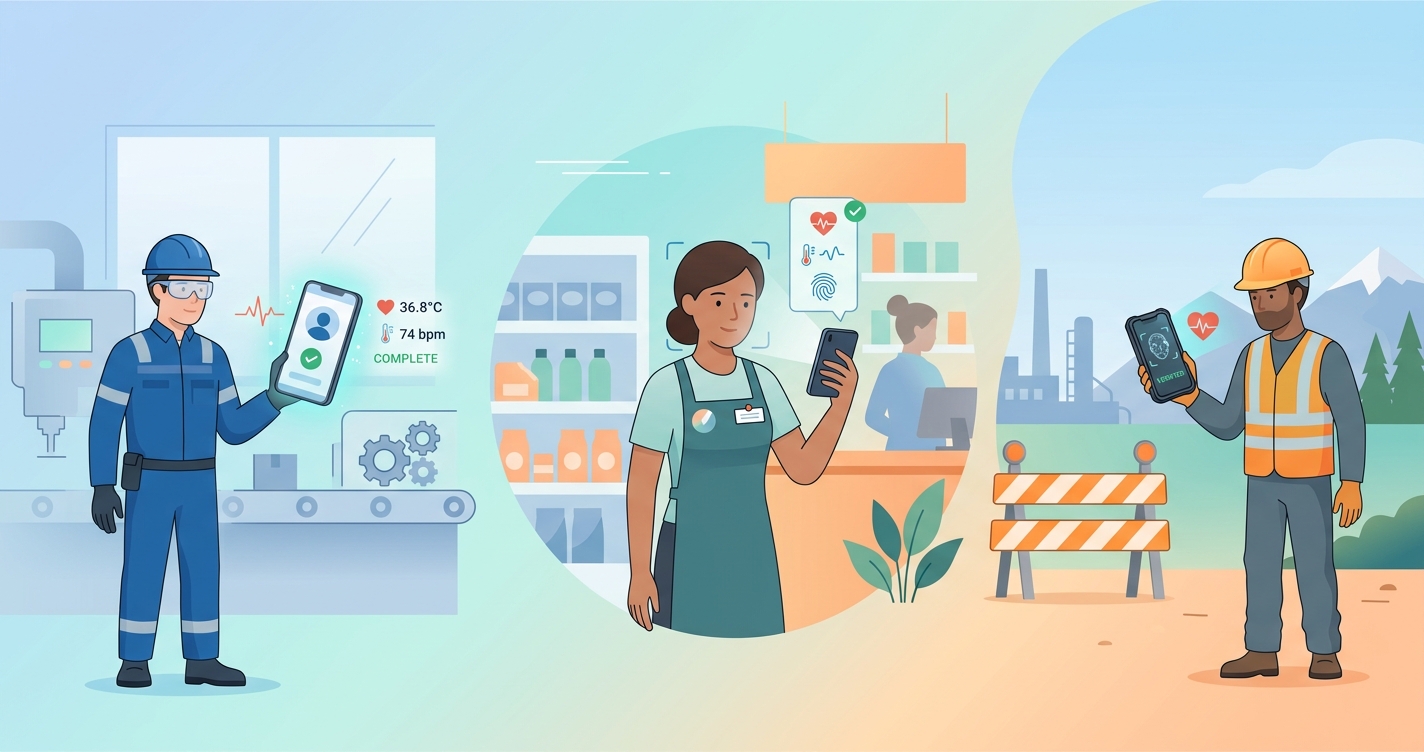
Manufacturing employers usually face a basic scheduling problem: three shifts, varying break patterns, and little tolerance for line disruption. In that setting, a smartphone or station-based screening model is easier to deploy than bringing in clinicians for repeated events. It also creates a common workflow across sites that do not have the same staffing profile or physical footprint.
Retail and hospitality
Retail and hospitality teams tend to have high turnover and variable schedules. The operational advantage of digital screening here is not just lower cost. It is repeatability. Employers can offer the same screening flow to a newly hired associate in week two that they offered to a veteran employee during annual benefits season.
Transportation, field service, and mobile crews
Workers who spend most of the day on the road are almost impossible to reach through event-based wellness. A digital model fits better because it follows the worker instead of requiring the worker to come to the program. That makes a difference for pre-shift checks, recurring engagement, and broader population health programs that depend on regular data capture.
Current research and evidence
The evidence base around digital screening for deskless workers pulls from several related research tracks rather than one perfect study.
First, the Illinois Workplace Wellness Study showed that screening rates can be increased, but that employers should not confuse higher screening volume with guaranteed downstream savings. That is an important discipline for benefits leaders. The metric that matters is not whether an event happened. It is whether hard-to-reach workers actually completed it and whether the data fed into follow-up care, coaching, benefits design, or risk stratification.
Second, BCG's 2024 research on deskless labor conditions helps explain why older screening models underperform. When 69% of deskless workers report burnout and 43% say they are looking for a new job, convenience is not a minor design preference. It is the enrollment strategy.
Third, the smartphone health literature points to both promise and caution. Nabe-Nielsen et al. found a fast-growing market for occupational health apps, but limited validation across many products. That argues for careful vendor evaluation rather than blind enthusiasm. Employers should ask how a screening tool fits existing workflows, how employees access it without corporate email dependence, and how results are routed to the next step.
Fourth, a 2022 Nature Communications paper by Ahn and colleagues described smartphone-based AI screening in low-resource community settings and reported that portable, phone-centered workflows could expand screening reach where traditional infrastructure was limited. The context was community health, not employer wellness, but the operational lesson carries over: when infrastructure is sparse, mobile-first screening becomes more practical than location-bound screening.
The future of digital screening for deskless workforces
The next phase is unlikely to be one big annual screening campaign. It will look more like distributed access.
Employers are moving toward a mix of channels: phone-based scans for workers who can use their own devices, fixed screening stations for plants and break rooms, and tightly targeted outreach tied to enrollment, return-to-work programs, or high-risk population management. The winners will probably be the organizations that stop treating deskless participation as an afterthought.
There is also a quieter shift happening in procurement. Wellness directors and benefits brokers are asking fewer questions about event staffing and more questions about adoption, completion time, multilingual flows, shift compatibility, and whether data can move into broader health operations. That is the right direction. Deskless workforce screening is really a distribution problem disguised as a wellness problem.
If you want a useful comparison point, our earlier posts on digital wellness for manufacturing workers and how to run biometric screening for a fully remote workforce show the same pattern from two different angles: access shapes participation more than most employers think.
Solutions like Circadify are being built around that reality, giving employers a way to extend screening beyond one-time events and into everyday workforce operations.
Frequently asked questions
What are deskless workers in a wellness program context?
Deskless workers are employees whose jobs do not revolve around a fixed computer workstation. That includes frontline and shift-based roles in manufacturing, retail, hospitality, transportation, field service, logistics, and similar settings. They are usually harder to reach through email-first or event-based wellness programs.
Why do deskless workers participate less in traditional biometric screening?
The biggest barriers are operational. Fixed appointment windows, unpaid time, travel, weak communication channels, and limited scheduling flexibility all reduce participation. In many cases, lower participation reflects lower access rather than lower interest.
What makes digital biometric screening better suited for deskless teams?
Digital screening can be completed on a smartphone or through a simple onsite station, which makes it easier to fit into shifts, breaks, and distributed work patterns. It also gives employers a more consistent workflow across multiple locations.
Does higher screening participation guarantee lower healthcare costs?
No. The best-known wellness research, including the Illinois Workplace Wellness Study, suggests that higher screening rates alone do not guarantee lower spending or better productivity. The value comes from what happens after screening: follow-up care, coaching, benefits integration, and sustained engagement.
Deskless workforces have been treated as the hardest audience in employer health, but that label misses the point. They are not unreachable. They are just poorly served by programs designed for someone else. Once screening is rebuilt around mobile access, shift realities, and simpler workflows, participation starts to look less mysterious and a lot more manageable.