How Population Health Vendors Use Screening Data to Stratify Risk
An evidence-based look at how population health vendors use screening data to stratify risk, segment members, and prioritize outreach in employer populations.
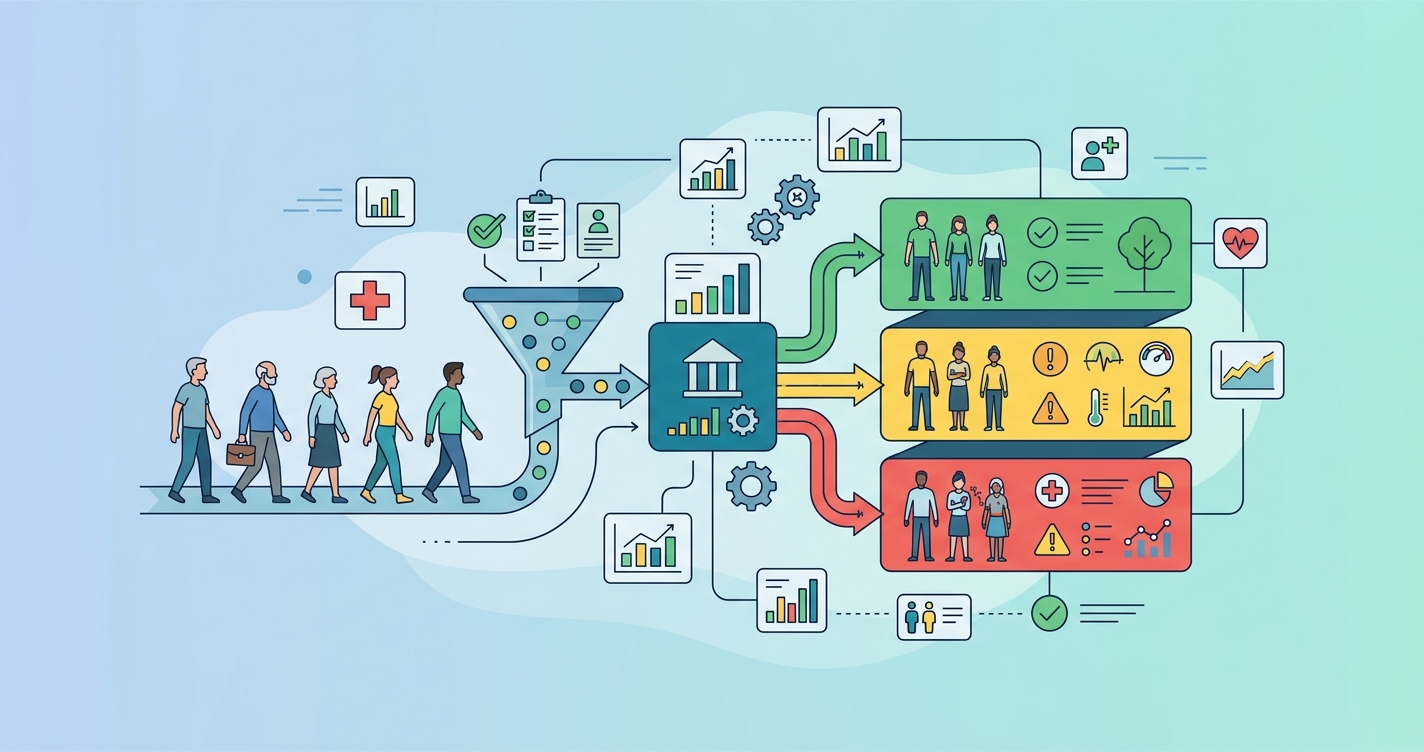
Population health screening data stratify risk in a much more practical way than most benefit decks admit. Vendors are not staring at a single biometric result and declaring who is healthy or unhealthy. They are combining screening inputs, utilization patterns, chronic condition flags, and engagement signals to decide who may need outreach now, who needs light-touch monitoring, and who can stay in a lower-cost digital pathway. For employers and benefits consultants, that distinction matters because the value is not in collecting data. It is in turning screening data into a usable intervention map.
“The program persistently increased health screening rates, but we do not find significant causal effects of treatment on total medical expenditures, other health behaviors, employee productivity, or self-reported health status after more than two years.” — Damon Jones, David Molitor, and Julian Reif, Quarterly Journal of Economics (2019)
How population health vendors use screening data to stratify risk
Most population health vendors start with a simple question: which members are most likely to benefit from immediate attention? Screening data helps answer that, but it rarely works alone. In employer populations, risk models usually combine four data layers:
- Biometric screening results such as blood pressure, BMI, glucose, or cholesterol
- Health risk assessment responses on sleep, exercise, stress, tobacco use, and family history
- Claims or diagnosis history when the employer or plan sponsor can legally share it
- Engagement data such as missed screenings, low app use, or gaps in follow-up care
That is why good risk stratification looks less like a leaderboard and more like triage. One employee may have borderline biometrics but rising pharmacy use. Another may have normal screening values yet repeated musculoskeletal claims and poor sleep. A third may have no major condition, but no preventive engagement at all. Vendors sort these patterns into cohorts so care management resources do not get spread evenly across the whole population.
| Risk tier | Typical signals used | Common outreach model | Why vendors use it |
|---|---|---|---|
| Rising risk | Early biometric drift, low activity, stress, missed preventive care | Digital coaching, nudges, education | Lower-cost intervention before claims intensity rises |
| Moderate risk | Multiple risk factors, repeat screenings outside target range, medication starts | Nurse outreach, condition-specific coaching | Prevent progression into higher-cost episodes |
| High risk | Established chronic disease, repeated acute utilization, multiple abnormal indicators | Care management, case review, physician coordination | Focus limited resources where cost and clinical impact are highest |
| Monitoring only | Stable biomarkers and strong engagement | Self-service wellness content, annual review | Avoid over-managing low-risk members |
The key point is that risk stratification is really resource allocation. Population health vendors use screening data because it gives them a current signal, especially when claims data arrives late.
Screening data is most useful when it is longitudinal, not one-time
A lot of employer programs still think in annual-event terms. That creates a blind spot. A single screening tells you where somebody stood on one day. Longitudinal screening tells you whether a population is drifting.
This is where many vendors have changed their operating model. Instead of using one biometric event as the whole program, they use recurring data collection to identify movement between tiers:
- Stable low-risk members who should stay in a light-touch pathway
- Rising-risk members whose blood pressure, sleep, stress, or weight trend is getting worse
- High-risk members who need care coordination instead of generic wellness messaging
That shift lines up with what the evidence says. In the Illinois Workplace Wellness Study, Damon Jones, David Molitor, and Julian Reif found that wellness programs can raise screening rates, but screening alone did not automatically produce lower spending or measurable downstream gains after two years. The implication is hard to ignore: more screening is not the same thing as better population management. Vendors need a workflow after the screening.
That is also why employers reading about what is continuous health engagement or how to measure wellness program impact on healthcare spending keep circling back to the same issue. The useful question is not whether a screening happened. It is whether the data changed who got contacted, coached, referred, or escalated.
What the data stack usually looks like in practice
Population health vendors usually build a stratification layer that blends screening data with administrative and behavioral inputs. The exact model differs by employer, but the architecture is surprisingly consistent.
| Data source | What it contributes | Limits if used alone |
|---|---|---|
| Biometric screening | Current physiological indicators and possible undiagnosed risk | Can overreact to one-time readings |
| Health risk assessment | Lifestyle, stress, sleep, readiness to change | Self-reported and sometimes incomplete |
| Medical and pharmacy claims | High-confidence utilization and diagnosis patterns | Often lagged by weeks or months |
| Demographic and job data | Age bands, shift work, location, benefit design exposure | Weak predictor without clinical context |
| Engagement data | Who responds to outreach and who disappears | Tells you behavior, not necessarily condition burden |
If there is one mistake employers make, it is expecting a biometric panel to function as a standalone population health engine. It is not. It is a trigger source.
Why employers increasingly care about rising-risk segmentation
The biggest spenders in a health plan matter, but so does the group just below them. Population health vendors often care most about rising-risk members because they are numerous enough to move trend lines and early enough to influence.
This is one of the more sensible lessons from the workplace wellness literature. Sandercock and Andrade, in a 2018 systematic review in the Journal of Obesity, found that worksite programs were more likely to affect body composition when they used repeated professional interaction and content tailored to participant needs. In plain English: generic messaging has weak lift. Programs work better when somebody gets the right intervention at the right moment.
For employers, that means screening data earns its keep when it helps answer questions like these:
- Which employees are moving toward hypertension, diabetes, or burnout risk but have not yet triggered high-cost claims?
- Which subgroups need a different outreach cadence, such as shift workers, deskless teams, or remote staff?
- Which risks are clustered together, such as sleep problems, stress, obesity, and musculoskeletal issues?
- Which members respond to digital coaching, and which need human follow-up?
The last question is underrated. Risk stratification is not just about clinical burden. It is also about intervention fit.
Industry applications for employer population health teams
Benefits consultants and brokers
Brokers often use stratified screening data to show employers where the workforce is fragmenting. One location may have strong participation but poor follow-through. Another may show concentrated cardiometabolic risk. The point is not to rank sites for optics. It is to decide where a vendor-led campaign, onsite navigation, or digital follow-up should start.
Corporate wellness directors
Internal wellness teams use screening cohorts to move beyond “one challenge for everyone” programming. If stress and sleep risk are clustering in one employee segment while metabolic risk is clustering in another, the program calendar should reflect that reality.
Population health vendors
Vendors use risk stratification to determine labor intensity. High-risk members may justify nurse outreach. Rising-risk groups may be routed into coaching pathways. Lower-risk groups may only need periodic check-ins and preventive reminders. Without segmentation, every member gets the same message and the same mediocre experience.
Self-insured employers
For self-insured buyers, the value is financial prioritization. If screening data helps identify which conditions are likely to drive future cost concentration, vendors can support more targeted interventions. That is the same logic behind how self-insured employers use wellness data to reduce costs: not every risk deserves the same spend.
Current research and evidence
The research base here is useful, but it also pushes back on a lot of vendor marketing.
Jones, Molitor, and Reif at the University of Illinois found in 2019 that workplace wellness programs increased health screening rates, yet they did not show significant causal effects on medical spending, productivity, or self-reported health after more than two years. That does not make screening useless. It means screening is a weak endpoint and a better input.
Vanessa Sandercock and Joana Andrade found in their 2018 systematic review that worksite nutrition and physical activity programs were more likely to change body composition when they involved frequent professional contact and content matched to participant needs. That supports a stratification model in which higher-risk or less-engaged groups get more tailored follow-up instead of identical outreach.
In a 2019 review in the Journal of Clinical Sleep Medicine, Nancy Redeker of Yale School of Nursing and coauthors looked at employer-initiated sleep interventions and found that workplace efforts tied to sleep hygiene, fatigue management, screening, and referral were associated with improvements in sleep-related outcomes, though the evidence base remained heterogeneous. For population health vendors, sleep data matters because it often travels with stress, safety risk, absenteeism, and cardiometabolic deterioration.
Rachel Thornton, Crystal Glover, Crystal Cené, Deborah Glik, Jeffrey Henderson, and David Williams wrote in Health Affairs that the opportunities available in homes, neighborhoods, schools, and workplaces have decisive effects on health outcomes. That broader point matters for vendor analytics too. Screening data gets sharper when employers interpret it alongside job design, access barriers, and social context instead of treating risk as an individual failure.
The future of screening-based risk stratification
The next phase is not more dashboards. It is faster signal detection and more precise escalation rules.
I keep coming back to one practical shift: employers are getting less interested in static wellness reports and more interested in operational segmentation. They want to know who needs a preventive nudge, who needs chronic care outreach, and who is likely to disengage before a condition becomes visible in claims. That is why digital screening keeps gaining attention. It can close the timing gap between annual events and delayed claims files.
Solutions like Circadify are being brought to market for organizations that want lower-friction digital screening options inside broader population health workflows, especially when the goal is to gather timely signals without relying on expensive onsite events. Employers exploring that model can learn more at circadify.com/industries/health-systems?utm_source=getcarescan.com&utm_medium=microsite&utm_campaign=population-health-risk-stratification.
Frequently Asked Questions
What does it mean to stratify risk with screening data?
It means using screening results as one input in a model that sorts members into groups such as low risk, rising risk, moderate risk, or high risk so outreach and care management can be prioritized.
Is biometric screening enough for population health risk stratification?
Usually no. Most vendors combine screening data with claims, health risk assessments, demographics, and engagement signals because a single screening snapshot can miss utilization trends or social context.
Why do population health vendors focus so much on rising-risk members?
Because this group is large enough to influence future cost and health trends, but still early enough for lower-cost interventions to work. High-risk members matter, but they are not the only segment that drives plan performance.
Does more screening automatically lower employer healthcare costs?
The evidence does not support that by itself. Research from Jones, Molitor, and Reif suggests screening rates can increase without producing measurable reductions in spending unless the program changes follow-up, care pathways, or engagement.