Why is my employer asking me to scan my face for wellness screening?
Why employers use facial wellness screening, what data may be collected, and what employees should know about privacy, consent, and workplace wellness programs.
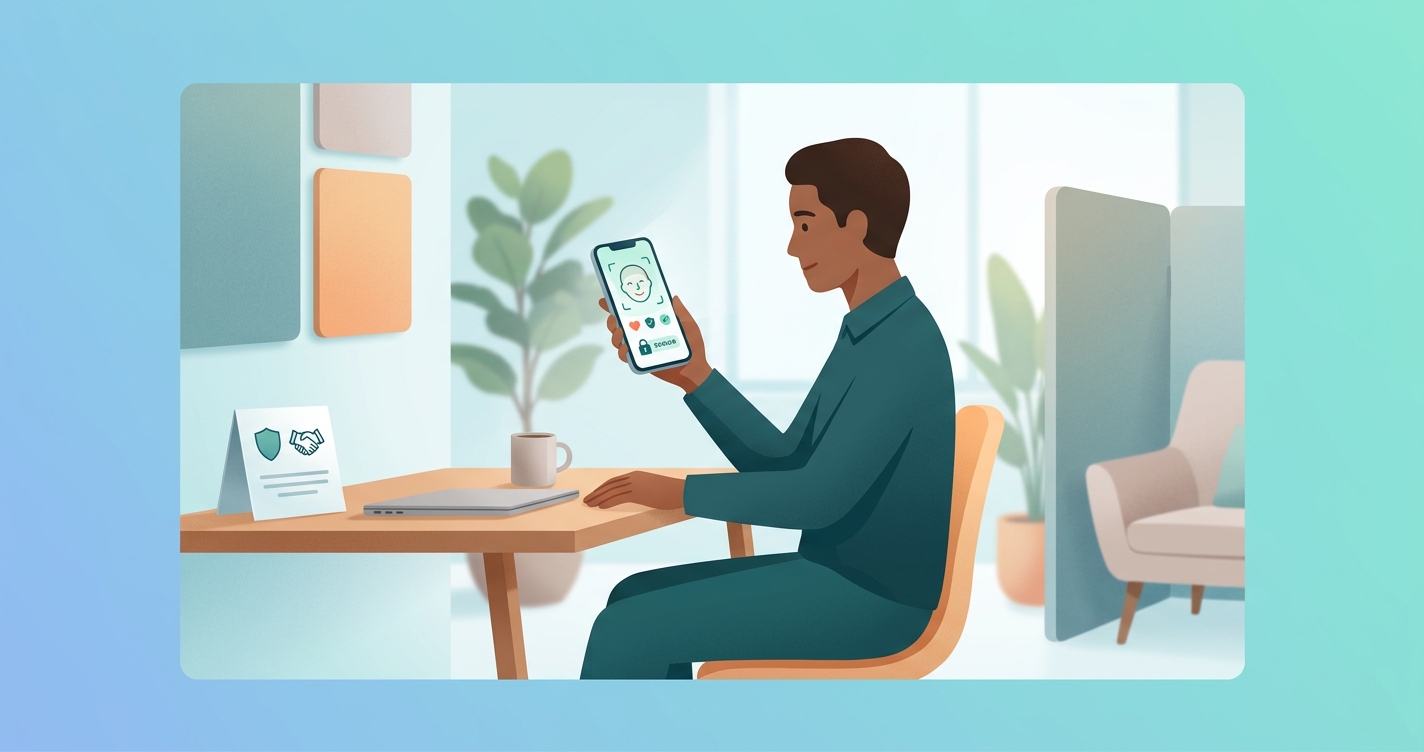
If your company recently asked you to complete an employer facial wellness screening, your first reaction was probably not curiosity. It was probably some mix of confusion, skepticism, and "wait, what exactly are they collecting?" That reaction is reasonable. Employers are under pressure to modernize wellness programs, cut the cost of onsite screening events, and reach remote workers. Employees, meanwhile, want a straight answer about what the scan is for, what happens to the data, and whether saying no will cost them.
"About 70% of U.S. adults oppose employers using facial recognition to analyze workers' facial expressions." That finding came from Pew Research Center researchers Lee Rainie, Monica Anderson, Colleen McClain, Emily A. Vogels, and Risa Gelles-Watnick in 2023. The message is pretty clear: people do not automatically trust face-based workplace monitoring.
Employer facial wellness screening: what your company is usually trying to do
In most cases, an employer is not asking for a face scan because HR suddenly wants to run surveillance. The business goal is usually much more ordinary: replace expensive onsite biometric events with a digital workflow that is easier to scale across hybrid, remote, and multi-location workforces.
Traditional wellness screening often means a one-day or one-week event with vendor staff, room bookings, scheduling, and a limited participation window. Digital screening promises a wider completion window and less operational hassle. RAND researcher Soeren Mattke and colleagues found in the corporation's landmark workplace wellness study that about four-fifths of large employers offered wellness programs, yet only 46% of employees completed a clinical screening or health risk assessment. That participation gap is one reason employers keep looking for lower-friction formats.
What changes with face-based or phone-based screening is the delivery model. Instead of sending every employee to a nurse station or health fair, the employer can offer a self-service option through a phone camera and web workflow. From the employer's side, that can mean:
- less event coordination
- broader access for remote and field employees
- faster reporting windows
- lower repeat costs if screening happens more than once a year
From the employee's side, though, the question is different. It is not "is this efficient?" It is "what are you doing with my face?"
| Question employees ask | Why the employer may be doing it | Why employees hesitate |
|---|---|---|
| Why scan my face at all? | To offer a remote screening workflow instead of an onsite event | Facial data feels more sensitive than filling out a survey |
| Is this the same as facial recognition? | Not always; some tools use the camera for physiological signals rather than identity matching | The distinction is rarely explained clearly |
| Is participation really voluntary? | Employers may link screening to incentives or plan design | Incentives can feel like pressure rather than choice |
| Who sees the data? | Usually a vendor, benefits platform, or wellness administrator | Employees worry data could flow beyond the intended use |
| Why now? | Hybrid work and cost pressure made event-based programs harder to run | New tech introduced without context tends to trigger distrust |
Why employers are shifting away from old wellness screening models
A lot of this shift has less to do with novelty and more to do with operations. Employers have been trying to solve the same problem for years: annual screening events are expensive, unevenly attended, and awkward for distributed workforces.
The RAND study, sponsored by the U.S. Departments of Labor and Health and Human Services, found that participation in many wellness activities stayed modest even when the programs themselves were common. In other words, offering a program is easy. Getting broad participation is not.
That matters because wellness screening only works as a population tool when enough people actually complete it. A remote employee in another state, a shift worker who misses the onsite event, or a worker who simply does not want to stand in line for a finger-stick test can fall out of the data set entirely.
That is why employers keep looking at digital alternatives. On this site, we have already covered how some organizations are trying to eliminate onsite biometric screening and why others are rethinking year-round wellness vs annual screening. Face-based workflows sit inside that larger move from event logistics to continuous access.
Industry applications
Large employers with scattered workforces
A company with multiple offices, retail sites, or field teams may be trying to replace a long list of local screening events with one standardized workflow. In that setting, a camera-based option is mainly about reach and consistency.
Benefits teams under cost pressure
Screening vendors, staffing, room scheduling, and lost employee time add up fast. A digital workflow can reduce some of that overhead, especially when the employer wants a broader participation window instead of one event day.
Employers trying to raise completion rates
Convenience matters. If screening can happen on a phone at home, during open enrollment, or over a multi-week period, the employer is betting more people will finish it.
Brokers and consultants comparing program models
Benefits advisors increasingly need to compare onsite events, lab-based options, and digital screening tools in a way clients can understand. Employees may see a face scan. Buyers often see a budget line and a participation forecast.
Current research and evidence
The privacy concern is not imagined. Pew's 2023 workplace AI survey found strong public discomfort with face-based monitoring on the job. The best-known figure was the 70% opposition to using facial recognition to analyze employees' facial expressions, but the broader finding matters too: workers tend to treat face-related technology as more intrusive than ordinary software tracking.
The legal and data-governance questions are also real. KFF Health News reported that workplace wellness programs can collect sensitive health details, including biometric data, while not always fitting neatly under HIPAA protections if the program is structured outside a group health plan. That article's reporting made a simple point that employees often miss: "wellness" does not automatically mean the same privacy rules apply as they would in a doctor's office.
The EEOC has its own lane here. Its enforcement guidance under the Americans with Disabilities Act says disability-related inquiries and medical examinations during employment generally must be job-related and consistent with business necessity, while separate wellness-program rules have long revolved around whether participation is truly voluntary. That is why employees often hear careful language about consent, incentives, and confidentiality.
There is also a practical reason employers should explain the technology plainly. When companies skip the explanation, employees assume the most invasive version of the story. They hear "scan your face" and think identity tracking, emotional analysis, or permanent storage. Sometimes the technology is much narrower than that. Sometimes the communication is just bad.
A useful employee checklist looks like this:
- ask whether the tool is measuring physiological signals, verifying identity, or both
- ask whether the image itself is stored or only derived measurements are retained
- ask who the vendor is and whether the employer receives individual or only aggregate data
- ask how long the data is kept and when it is deleted
- ask whether participation affects premiums, incentives, or eligibility
- ask whether there is a non-camera alternative
Those questions are not paranoia. They are basic due diligence.
The future of employer facial wellness screening
Employers will probably keep testing camera-based wellness workflows because the business case is easy to understand. Fewer onsite events. Wider access. Lower administrative drag. Better alignment with a workforce that expects phone-first tools.
But adoption will depend less on the novelty of the technology and more on whether trust holds up.
If an employer introduces face-based wellness screening with clear consent language, a realistic explanation of what is and is not being collected, and an alternative path for employees who are uncomfortable, the program has a better chance of landing well. If the rollout feels vague or coercive, resistance is almost guaranteed.
That is the part some wellness buyers underestimate. Employees are not only evaluating the tool. They are evaluating whether the employer has earned enough trust to ask for something that feels personal.
Frequently asked questions
Does a facial wellness screening mean my employer is using facial recognition?
Not necessarily. Some systems use a phone camera to estimate physiological signals during a screening workflow rather than to identify a person across databases. But employees should not assume that distinction. Ask directly how the system works and what data is retained.
Is my employer allowed to ask for this kind of scan?
That depends on how the program is structured, what data is collected, and which laws apply. EEOC rules, ADA and GINA requirements, state biometric privacy laws, and plan-specific privacy practices can all matter. The practical question for employees is whether participation is truly voluntary and clearly explained.
Is wellness-program data always protected by HIPAA?
No. KFF Health News has reported that some workplace wellness programs fall outside the strongest HIPAA protections, especially when they are not operated as part of a covered group health plan. Employees should ask who holds the data and which privacy rules govern it.
Why would an employer prefer this over an onsite screening event?
Usually because digital screening is easier to deploy across hybrid and multi-site workforces, can reduce event costs, and may improve completion rates by giving employees a longer and more flexible window.
If you are the employee asking this question, the short answer is that your employer is probably trying to modernize wellness screening, not turn the office into a sci-fi surveillance lab. Still, the privacy questions are legitimate, and employers ignore them at their own risk. For benefits leaders evaluating these programs, the bigger issue is whether the workflow is transparent enough to earn trust while still reducing the cost and friction of traditional screening. Circadify is one of the companies addressing that shift toward digital, phone-based screening workflows for employers and health systems. You can learn more about that broader model at circadify.com.